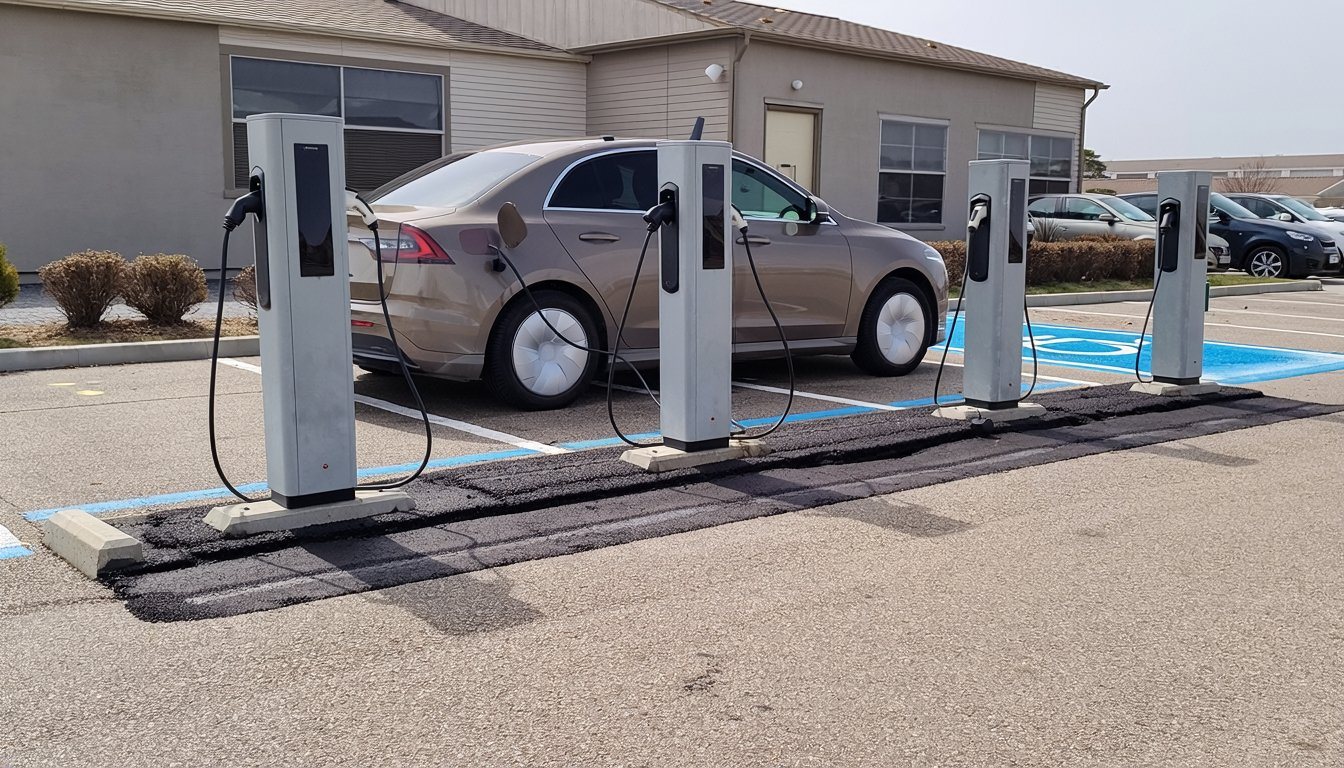
Most business owners pricing EV charging start with the charger itself. That's the most predictable number in the project. What moves the budget is everything between the utility's power and the parking space: how far the power has to travel, whether the site has the electrical capacity, what it takes to make the spaces accessible, and what the permits and site work add along the way.
Quick answers
- Level 2, installed: one installer network puts commercial Level 2 at $3,500 to $15,000 per port.
- DC fast, installed: the same source puts DC fast charging at $18,000 to $350,000 or more per port.
- The site drives the spread: in our experience, trenching, electrical capacity, accessible spaces, and permits often matter more than the charger.
- The federal credit has ended for new installs: it doesn't apply to property placed in service after June 30, 2026.
Per-port cost: Level 2 vs. DC fast
The federal Alternative Fuels Data Center gives rough equipment figures: "[P]ublic charger costs are approximately $3,500 per connector for Level 2 and $38,000 to $90,000 per connector for DC fast," and says DC fast installation "can range anywhere from $20,000 per connector to $60,000" per connector, depending on charger power and the number of chargers installed per site. The page doesn't show an update date, so treat those as broad estimates. For home charging decisions, see do you need a Level 2 charger at home. For choosing between Level 2 and DC fast by how long cars stay, see our guide to the best commercial EV charging solutions.
Qmerit, an installer network, publishes installed ranges that include equipment and installation:
| Charger type | Installed cost per port (Qmerit) |
|---|---|
| Level 2 | "$3,500 to $15,000 per port" |
| DC fast | "$18,000 to $350,000+ per port" |
The width of those ranges is the point. The charger is a fairly known quantity; the site is not.
Two ways the published numbers are built
The two sources above don't measure the same thing, and mixing them is an easy way to end up with a budget that's wrong in both directions. The Alternative Fuels Data Center separates equipment from installation. Alongside the roughly $3,500 equipment figure, its page lists public and workplace Level 2 installation at "around $2,500 per connector". Qmerit, by contrast, quotes one installed figure per port that already includes both.
Add the AFDC pair for a Level 2 port and you get about $6,000 ($3,500 plus $2,500), which sits in the lower half of Qmerit's $3,500 to $15,000 installed range. In our experience, a gap like that usually comes from site conditions: a short run from the electrical room lands near the AFDC number, while a long trench, a service upgrade, or accessible-space work pushes a quote toward Qmerit's upper end. Pick one method, apply it consistently, and use the other as a cross-check rather than something to add on top.
What sits behind the charger
These are the items that usually decide whether a project lands at the low or high end, with the rates Qmerit publishes where it gives them:
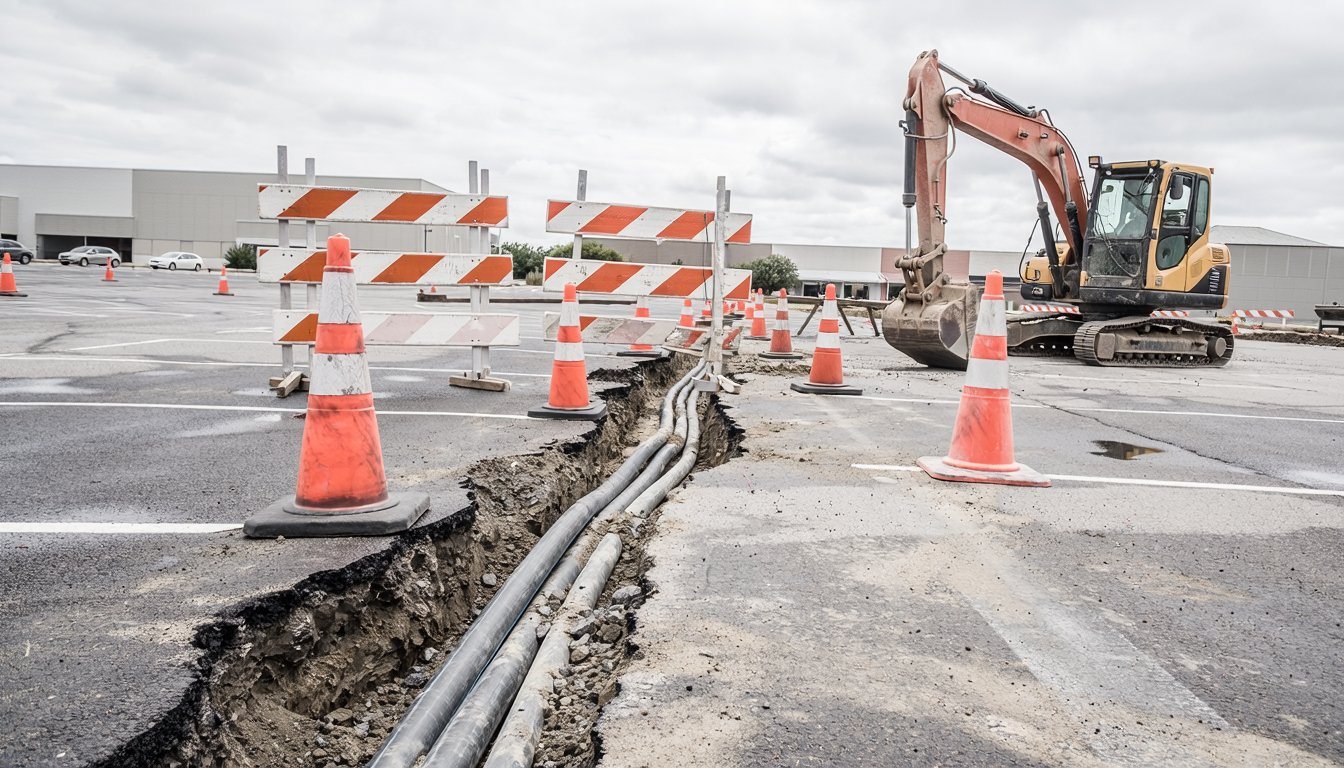
- Trenching. Getting power from the electrical room to the parking spaces in our experience often means cutting and restoring pavement, at "$75–$150 per linear foot." Our trenching cost calculator walks through how trench costs add up.
- Electrical capacity. If the building's service can't carry the new load, the project may need a service upgrade or utility transformer work. That cost depends on the site and the utility, so get the utility involved early rather than assuming a number.
- Accessible spaces. Qmerit lists ADA compliance at "$3,000–$7,000 per charging space."
- Permitting. Qmerit estimates permitting at 3% to 5% of total project cost.
- Site safety and traffic control. Qmerit lists this at "$1,000–$3,000 per project," most relevant when work happens in an active parking lot.
Electrical capacity: the line item nobody can price first
Trenching has a published rate. Electrical capacity doesn't, because it depends on what the building already has and what the utility says it can add. Qmerit says electrical infrastructure, site conditions, and utility requirements often drive the final project cost. California's Governor's Office of Business and Economic Development, in its permitting guidebook, is blunter about the risk: "Utility energization can add considerable cost when major upgrades are required".
The AFDC advises site hosts to "engage with utilities early in the infrastructure planning process," and lists "Proximity to incoming electricity and potential metering enhancements" among the things to weigh when choosing where chargers go. In our experience, the two questions that save the most money are how much spare capacity the existing service has and how far the chargers sit from the main switchboard. Both can be answered before anyone draws a site plan. For what a service upgrade itself runs, see our electrical panel upgrade cost guide, and for conduit priced by the foot, see underground conduit installation cost per foot. If you lease the property, the lease's work letter may decide who can add that capacity; our shell and tenant improvement guide explains how.
Accessible spaces: why the cost is per space, not per charger
The $3,000 to $7,000 per space line exists because an accessible charging space is more than a charger. The AFDC says ADA-compliant stations need "adequate space for exiting and entering the vehicle, unobstructed access to the charging station" and clear paths to building entrances. The U.S. Access Board adds specifics, including that "Clear floor or ground space at chargers must be a minimum of 30 inches by 48 inches." In our experience, that translates into grading, striping, signage, and sometimes a new path of travel, none of which shows up on a charger's spec sheet.
How many accessible spaces you need is a local question. The AFDC page doesn't give a universal minimum number of accessible ports, and it says that "State or local codes may have specific requirements" covering design, marking, signage, and the minimum number of accessible charging ports. It adds that California has "issued accessibility regulations that include a minimum number of accessible charging stations for public and shared use". For a design benchmark, the Access Board "recommends designing at least two EV charging spaces with accessible mobility features". At Qmerit's rate, two accessible spaces would be $6,000 to $14,000 for that work alone. Whether that sits inside or on top of a bidder's per-port price depends on the quote, so ask. For a related look at accessible-route costs, see our ADA ramp cost guide.
Permits, licensing, and soft costs
The AFDC says installations must "comply with local and state codes and regulations and be completed by a licensed electrical contractor," and that permitting could require a site installation plan and approval "from fire, environmental, or electrical inspection entities." The California guidebook notes that "AB 970 codifies specific binding timelines for project review and approval." That guidebook is the second edition, dated January 2023 in its text, so confirm current timelines with the local building department rather than relying on it.
Permitting isn't the only percentage line. Qmerit puts project management at 3% to 5% of total project cost, the same range it gives for permits. On a $60,000 project, that means $1,800 to $3,000 for permits and another $1,800 to $3,000 for project management, or $3,600 to $6,000 combined. In our experience, these soft costs are the ones owners forget to budget, because they never appear in a charger price list.
Why more chargers can mean a lower cost per port
The Alternative Fuels Data Center notes that "labor is the largest expense in a typical installation", and that the per-charger cost falls for larger installations. Much of the fixed work, such as the trench, the electrical upgrade, and the permit, is shared across every charger on the run. In our experience, that's why planning for future chargers during the first project, for example by installing extra conduit while the trench is open, is usually cheaper than coming back later. For what makes a site a true charging hub, see our explainer on commercial EV charging hubs.
The federal credit has ended for new installs
The IRS instructions for the charging credit are direct: "You can't claim the credit for alternative fuel vehicle refueling property placed in service after June 30, 2026". For business property placed in service before that date, the credit was generally 6% of cost, or 30% if prevailing wage and apprenticeship requirements were met, up to $100,000 per item, and the property had to be in an eligible census tract. If you have a project that may have been placed in service before the cutoff, confirm eligibility with your tax advisor.
A worked example
Say a small business wants four Level 2 ports. Using Qmerit's installed range of $3,500 to $15,000 per port, that's roughly $14,000 to $60,000. Because that range already includes installation, don't add site items on top of it; instead, expect a long trench, an electrical upgrade, or accessible-space work to push the project toward the top of the range or beyond it. For scale, a 100-foot trench alone at Qmerit's trenching rate would be $7,500 to $15,000. This is an illustration from published ranges, not a quote.
A DC fast example works the same way, using one source at a time. Take two connectors at the AFDC's figures. Equipment at $38,000 to $90,000 per connector comes to $76,000 to $180,000, and installation at $20,000 to $60,000 per connector adds $40,000 to $120,000, for a total of $116,000 to $300,000. Qmerit's installed range for the same two ports would be $36,000 to $700,000, which shows how much power level and site conditions matter. Neither number is a quote, and a utility upgrade could move a DC fast project well outside either range.
What a commercial quote should itemize
A useful quote separates the charger hardware from the site work: trenching and paving restoration, electrical work and any service upgrade, accessible-space work, permits, and ongoing costs such as networking. Qmerit lists network software at "$275–$480 per port per year." With those lines separated, bids become comparable.
A few decisions belong on the table before bids go out, because each one changes the numbers. The AFDC lists "Future expansion" as a site consideration, which is where the extra conduit idea from earlier gets decided. It also lists "Proximity to a wireless internet connection, if needed," which matters for networked chargers. And the type of charger should follow how long vehicles stay, a question our guide to the best commercial EV charging solutions covers. Written answers to these give every bidder the same starting point.
Medici Construction Group is one licensed option for the construction side of a charging project, such as trenching, concrete, and site work, holding California A, B and C-10 licenses under CSLB #1114433. For charging at home rather than a business, see our EV charger installation cost guide.
Frequently asked questions
How much does a commercial EV charging station cost?
One installer network puts commercial Level 2 at $3,500 to $15,000 per port installed and DC fast charging at $18,000 to $350,000 or more per port. In our experience, the site work behind the charger drives most of that spread. Our guide to commercial EV charger installation walks through that work step by step.
How much does a DC fast charger cost for a business?
The Alternative Fuels Data Center estimates DC fast equipment at $38,000 to $90,000 per connector, plus installation of $20,000 to $60,000 per connector depending on charger power and site.
Is there still a federal tax credit for commercial EV chargers?
Not for new installs. The IRS says the credit can't be claimed for property placed in service after June 30, 2026. Check with a tax advisor about anything placed in service earlier.
What makes commercial EV charger installation expensive?
In our experience, mostly the site: trenching and pavement restoration, electrical capacity and any service upgrade, accessible-space requirements, and permits. The charger itself is the more predictable part.
Is it cheaper per port to install more chargers?
Usually. The Alternative Fuels Data Center notes that per-charger cost goes down significantly for larger installations. In our experience, that's partly because trenching, electrical work, and permits are shared across more ports.
Does a commercial EV charger have to be installed by a licensed electrician?
The Alternative Fuels Data Center says installations must comply with local and state codes and regulations and be completed by a licensed electrical contractor. In our experience, trenching, paving, and concrete work are often handled by a separate licensed contractor.
How many accessible EV charging spaces does a business need?
It depends on local and state code. The Alternative Fuels Data Center says California has issued regulations with a minimum number of accessible stations for public and shared use, and the U.S. Access Board recommends at least two spaces with accessible mobility features. Confirm the count with the local building department.