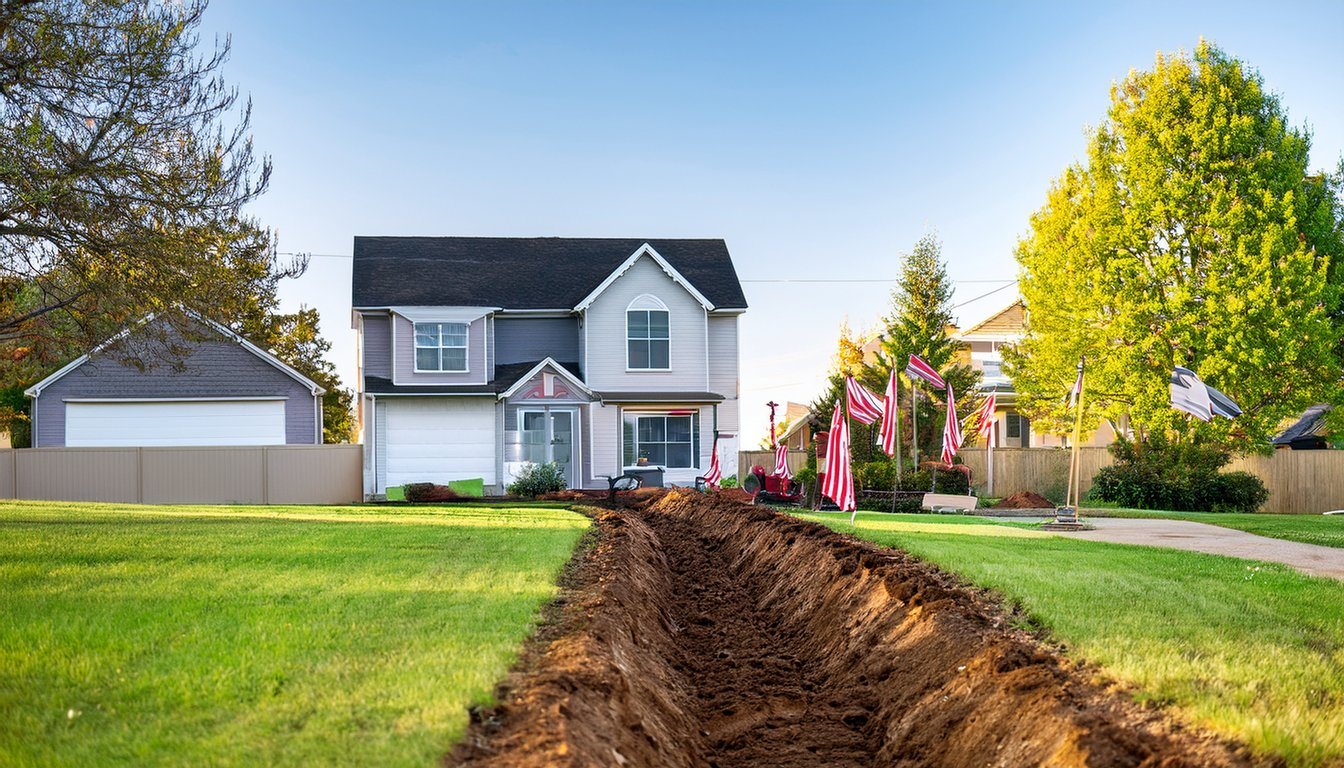
Most trenching prices you'll find online are a single number per linear foot. That number covers digging, and that's all it covers. A real trench estimate has four lines: digging, backfill, repairing whatever surface the trench crosses, and locating utilities and permitting. On a trench that runs across a driveway, the surface line alone can come close to the cost of the digging.
Quick answers
- Line 1, digging: length × a per-foot rate. HomeGuide puts standard trenching at $5 to $12 per linear foot.
- Line 2, backfill: often little or nothing if the dug soil goes back in; more if fill has to be brought in.
- Line 3, surface repair: lawn is cheap to restore, pavement isn't. Asphalt patching runs $4 to $12 per square foot for a saw-cut repair, per HomeGuide.
- Line 4, locate and permit: 811 utility marking is free; earthwork permits, where required, run $50 to $400 according to HomeGuide.
- Worked example: a 100-foot trench with a 40-foot driveway crossing comes to roughly $820 to $2,160 before any permit.
What this calculator covers
This is for residential, utility-sized trenches: a line for electrical conduit, a water or gas line, irrigation, or a drain. It assumes a narrow trench dug by machine. For digging a wide area, such as a footing, a patio base, or a pad, the math is volume-based instead, and our excavation cost calculator covers that. Everything below uses published national figures, so it's a way to build your own estimate and check a quote, not a replacement for one. For installed per-foot rates on complete drainage systems, see yard drainage cost per foot.
Line 1: digging, by the foot
Start with the trench length and multiply it by a per-foot rate. HomeGuide lists trenching at "$5 to $12 per linear foot," and Angi uses the same standard range, adding that "complex jobs" can reach "$13 to $40 per linear foot." Soil, depth, rock, and obstructions decide which end of those ranges your trench lands on. For what moves that rate, and ranges by type of job, see our trenching cost per foot guide.
Depth also has a threshold worth knowing. Angi notes that the majority of trench projects are less than five feet deep, and that "if your project requires digging a trench that's deeper than five feet, you'll need to factor in the extra cost of adding shoring or protective barriers."
Line 2: backfill
On many utility trenches, the soil that comes out goes back in once the line is laid, so backfill is mostly labor and may already be folded into the digging price. Ask. If the excavated soil isn't suitable or the job calls for imported fill, calculate the trench volume the same way you would for any dig: length × width × depth in feet, divided by 27 for cubic yards. Angi puts fill dirt at "between $5 to $15 per cubic yard or $150 to $450 per truckload." Our trenching and backfilling cost guide prices imported fill, bedding sand and haul-off in detail.
Line 3: surface cut and repair
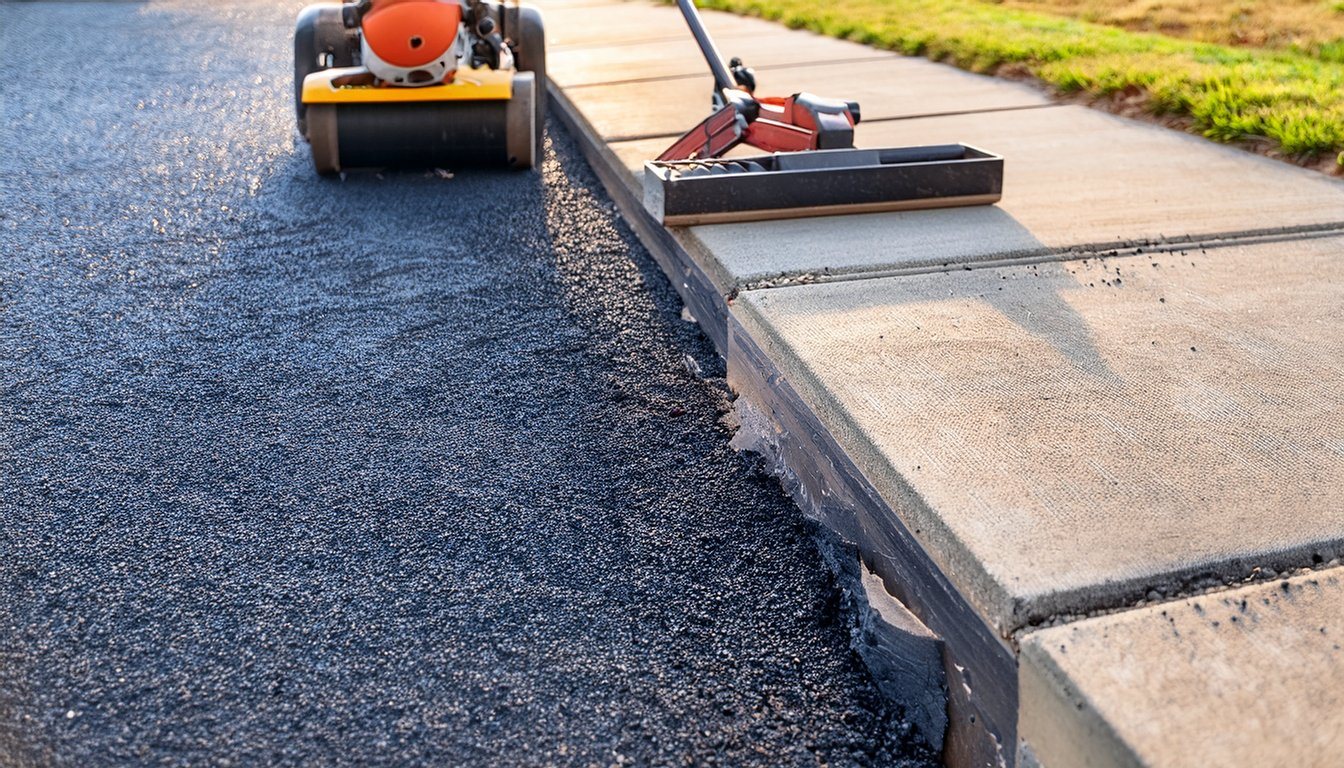
This is the line that surprises people. A trench across lawn needs soil and seed or sod. A trench across a driveway or walkway means cutting the pavement and patching it afterward. For asphalt, HomeGuide lists a saw-cut patch at "$4 – $12" per square foot and notes "a minimum service fee of $100 to $250 applies." Measure the patch, not just the trench: in our experience, the repair strip is often wider than the trench itself. Concrete, pavers, and established landscaping vary too much to price from a published range, so get those quoted.
Line 4: locate and permit
Before any digging, buried utilities need to be marked. The national before-you-dig service describes itself plainly: "811 is the free national before-you-dig service," and advises contacting it "a few business days before you begin any digging." Marking is free; the cost is lead time, so build it into the schedule.
Permits depend on your jurisdiction and on what's going in the trench (electrical, gas, and plumbing lines may need separate trade permits; check with your building department). For earthwork itself, HomeGuide says "permits for earthwork cost $50 to $400, depending on location."
Worked example
Say you need a 100-foot trench, 1 foot wide and 2 feet deep, for a new line to a detached garage. The dug soil goes back in, and 40 feet of the run crosses an asphalt driveway. For the patch, assume the repair strip is 2 feet wide, a bit wider than the trench; that width is an illustrative assumption, not a sourced figure.
| Line | Calculation | Result |
|---|---|---|
| 1. Digging | 100 ft × $5 to $12/ft | $500 to $1,200 |
| 2. Backfill | Soil reused; no imported fill | $0 (labor assumed in line 1; confirm) |
| 3. Asphalt patch | 40 ft × 2 ft = 80 sq ft × $4 to $12/sq ft | $320 to $960 |
| Subtotal, no permit | Lines 1 to 3 | $820 to $2,160 |
| 4. Permit, if required | $50 to $400 | $870 to $2,560 total |
Two notes on the math. The asphalt minimum fee doesn't matter here because the patch is large enough to exceed it; on a short crossing, you'd pay whichever is higher, the per-square-foot total or the minimum. And if the soil had to be replaced with imported fill, the trench volume is 100 × 1 × 2 = 200 cubic feet, or about 7.4 cubic yards, which at $5 to $15 per cubic yard adds roughly $37 to $111. In this example, the driveway crossing costs close to what the digging does, which is exactly why a per-foot price alone can mislead.
How much of the total is the patch?
The example is easier to trust once you see where the money sits. The 40-foot driveway stretch is 40 feet of the 100-foot run, so its digging is 40 × $5 to $12, or $200 to $480. The patch on that same stretch is $320 to $960. That is 1.6 times the digging at the low end (320 ÷ 200) and 2.0 times at the high end (960 ÷ 480). Across the whole job, the patch is 39 to 44 percent of the $820 to $2,160 subtotal (320 ÷ 820 and 960 ÷ 2,160). The other 60 feet carries no surface repair line in this example, so it is the cheap part of the job.
That is also why the route matters more than the length. Moving the same trench so it crosses the driveway at a single 10-foot strip instead of 40 feet changes the patch from 80 square feet to 20 (10 × 2). At $4 to $12 per square foot, that is $80 to $240, but HomeGuide's "minimum service fee of $100 to $250" would apply instead, so the line becomes roughly $100 to $250 rather than $320 to $960. Treating the low and high ends as a pair is a simplification, but it shows the point: shortening the pavement crossing saves more than shortening the trench.
Changing the width and depth inputs
The volume formula only matters for imported fill or haul-off, but it is worth running with your own dimensions. Homewyse prices its base trench as "Excavate 0.2m/8" wide trench up to depth of 0.6m/2ft in non-rocky soil" on its own calculator page, which is narrower than the 12-inch trench in our example. Run the volume both ways over 100 feet. At 8 inches wide (8 ÷ 12 = 0.667 feet) and 2 feet deep, the volume is 100 × 0.667 × 2 = 133.3 cubic feet, or 4.94 cubic yards after dividing by 27. At 12 inches wide it is 200 cubic feet, or 7.41 cubic yards. Widening the trench from 8 to 12 inches, which is half again as wide, adds half again as much soil to move, because volume scales with width. If a machine can only cut one width, use its width rather than the narrowest number you can find.
Depth works the same way. Deepening the same 12-inch trench from 2 feet to 3 feet takes the volume from 200 to 300 cubic feet (100 × 1 × 3), or 11.1 cubic yards. That is a 50 percent increase in soil, and it also moves you closer to the five-foot depth at which Angi says shoring becomes a cost.
Adding contractor markup
The published per-foot ranges are not always what a contractor will bill you. Homewyse states, "Add 13% to 22% to the total cost above if a general contractor will supervise this project" and separately lists "Permit or inspection fees (or portion thereof) required by your local building department for your overall project" as outside its price. That markup applies when a general contractor is coordinating the work, for example when the trench is one piece of a larger project. Applying it, as an illustration, to the example's $820 to $2,160 subtotal gives $926.60 at the low end (820 × 1.13) and $2,635.20 at the high end (2,160 × 1.22). Adding the $50 to $400 permit range afterward gives about $977 to $3,035. A permit fee is normally a pass-through, so it is added after the markup, not before; whether a given contractor marks it up is a question for the quote.
Doing it yourself
HomeGuide splits typical trenching into equipment at "$2 – $3" per linear foot and labor at "$3 – $9" per linear foot, which is roughly what doing it yourself replaces. Angi lists "a daily cost of $125 per day to rent a micro-trencher." A larger machine costs more: Angi's rental guide says "Trencher rentals range from $100 to $620 per day, with walk-behind models costing less than ride-on." The same guide tells renters to budget for fuel, delivery, site prep such as permits and land surveys, and backfilling on top of the rental rate.
To compare, assume the 100-foot digging line takes one rental day, which is an assumption, not a sourced figure. A contractor's digging line was $500 to $1,200. A one-day rental at the $280 average Angi reports leaves $220 to $920 of difference (500 − 280 and 1,200 − 280) before fuel, delivery, and your own time, and before you learn to run the machine. The surface repair, permit, and 811 call still apply either way, and lines carrying electrical, gas, or water service may need an inspection before backfill, so confirm the requirements locally before you dig.
Using this to check a quote
Run your own numbers through the four lines before comparing bids, then check that each quote addresses all four: the per-foot or total digging price, whether backfill and compaction are included, what surface restoration is included and to what standard, and who is handling the permit and utility locate. In our experience, a quote that's far below your estimate often turns out to be missing the surface line; one far above may include work like shoring or rock removal that's worth asking about. Medici Construction Group is one licensed option for trenching and site work, holding California A, B and C-10 licenses under CSLB #1114433.
Frequently asked questions
How do I calculate trenching cost?
Add four lines: trench length times a per-foot digging rate, backfill (little if the soil goes back in, more if fill is imported), repair of any pavement or landscaping the trench crosses, and permit fees where required. The 811 utility locate is free.
Does a per-foot trenching price include everything?
Usually not. A per-foot rate covers the digging. Surface repair, imported fill, and permits are often priced separately, and pavement repair in particular can add as much as the digging on a trench that crosses a driveway.
How much does it cost to trench 100 feet?
For digging alone, HomeGuide's $5 to $12 per linear foot works out to $500 to $1,200. Add surface repair and any permit; in our worked example with a 40-foot driveway crossing, the total comes to roughly $820 to $2,160 before a permit.
Does trenching cost include backfill?
Often, when the dug soil goes back into the trench, but not always. Ask whether backfill is included and whether imported fill would be extra.
Do I need to call 811 before trenching?
Yes. 811 is the free national before-you-dig service, and it asks you to contact it a few business days before digging so buried utilities can be marked.
How long does it take to dig a trench?
It depends on length, soil, and what the trench crosses. In our experience, a short residential utility trench in workable soil can often be dug in a day, while pavement cutting, rock, or tight access add time, and the 811 notice period comes before any of it.