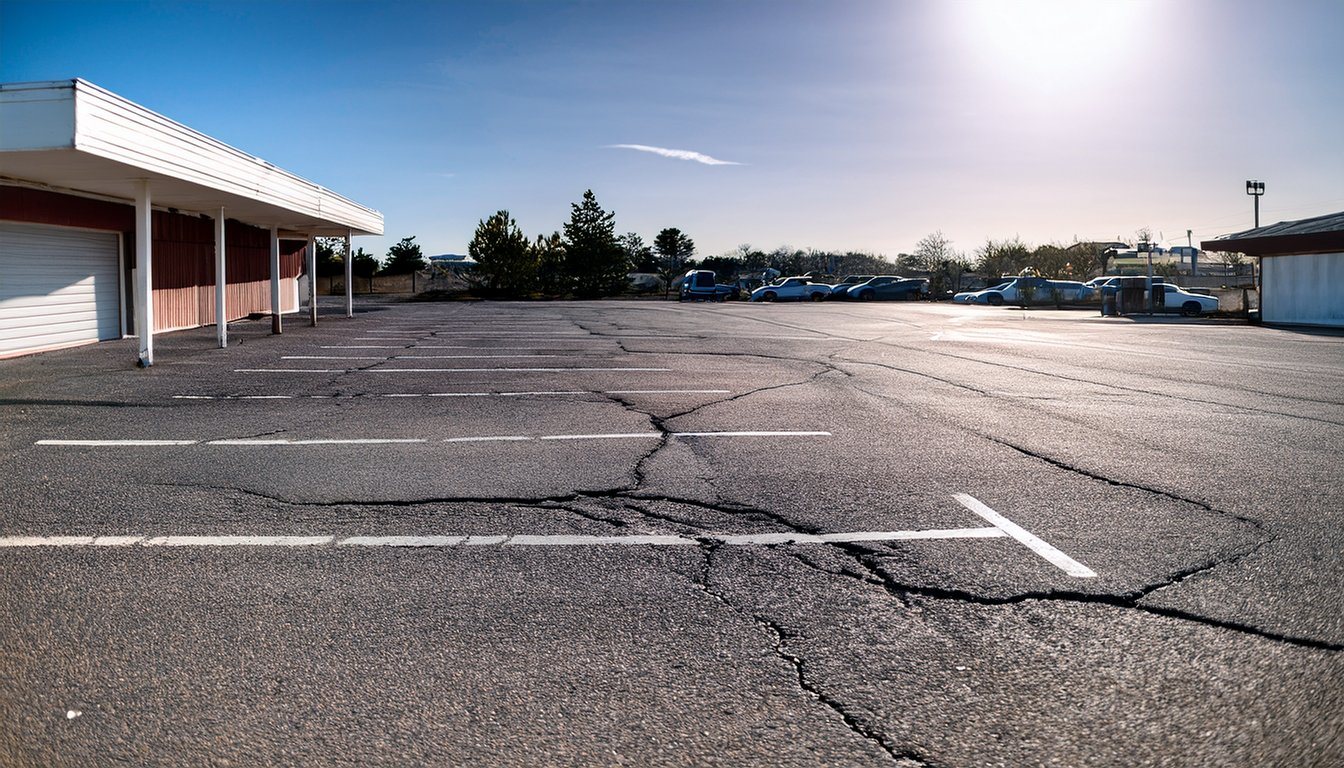
Two parking lots of the same size can get repair bids tens of millions of dollars apart. One has a scatter of thin cracks and a few worn stripes. The other has a patch of cracking in the main drive aisle that looks like the skin of an alligator, and a couple of potholes forming where delivery trucks turn. The size of the lot matters, but what's wrong with it matters more. Most parking lot damage points to one of a handful of repairs, and each one is priced in its own unit: linear feet of crack, square feet of patch, square feet of overlay, number of stalls. This guide shows how to read the damage, what each repair costs according to published guides, why waiting raises the bill, and what restriping means for accessible parking.
Quick answers
- The repair type drives the bill: crack sealing and small patches are the cheapest per unit; resurfacing, mill and overlay, and full-depth repairs are the big-ticket items.
- Read the cracks first: thin, straight cracks usually just need sealing; alligator cracking points to a failed base that needs digging out.
- Waiting costs more: the Federal Highway Administration says repair or rehabilitation costs six to eight times more than preventive treatments.
- Restriping has a legal side: the Justice Department says a business that restripes must provide accessible spaces as required by the ADA standards.
Read the damage first
The fastest way to understand a repair bid is to know what the damage on your lot means. The PASER manual, a pavement rating guide published by the Wisconsin Transportation Information Center, matches common asphalt distresses to repairs. Its asphalt roads manual is written for roads, but the same logic applies to parking lots: Our overlay vs seal coat guide explains which finish fits each condition once repairs are done.
| What you see | What it usually means | PASER's repair |
|---|---|---|
| Single cracks running across the pavement (transverse) | Aging and temperature movement | "Prevent water intrusion and damage by sealing cracks which are more than 1⁄4" wide." |
| Cracks forming large rectangular blocks | The asphalt has hardened and shrunk with age | "Repair with seal coating during early stages to reduce weathering of the asphalt. Overlay or reconstruction required in the advanced stages." |
| Small interconnected cracks (alligator) | Traffic fatigue, often with weak base or subgrade | "Repair by excavating localized areas and replacing base and surface. Large areas require reconstruction." |
| Loose stones and a rough, worn surface (raveling) | The surface is wearing away | "Protect pavement surfaces from the environment with a sealcoat or a thin overlay if additional strength is required." |
| Potholes | Material lost through the full asphalt layer | "Repair by excavating or rebuilding localized potholes. Reconstruction required for extensive defects." |
Alligator cracking deserves the most attention. PASER says it is "caused by failure of the surfacing due to traffic loading (fatigue) and very often also due to inadequate base or subgrade support." That's why a cheap skin patch or sealcoat over alligator cracking rarely lasts: the problem is underneath. Our parking lot sealcoating cost guide explains why sealcoat can't fix it.
What each repair costs
Cost guides price each repair in its own unit, and ranges vary by source and region, so treat these as starting points rather than quotes. Here's one published range for each common repair:
| Repair | When it's used | Published range | Source |
|---|---|---|---|
| Crack sealing or filling | Thin cracks in otherwise sound pavement | $1 to $3 per linear foot | Pavemade (paving contractor) |
| Pothole patching | Isolated potholes | $25 to $40 per pothole, plus $100 to $250 to bring out the crew | Home Guide |
| Full-depth patch (remove and replace) | Alligator cracking and failed base in one area | $5 to $12+ per square foot (HomeGuide's driveway figure) | Home Guide |
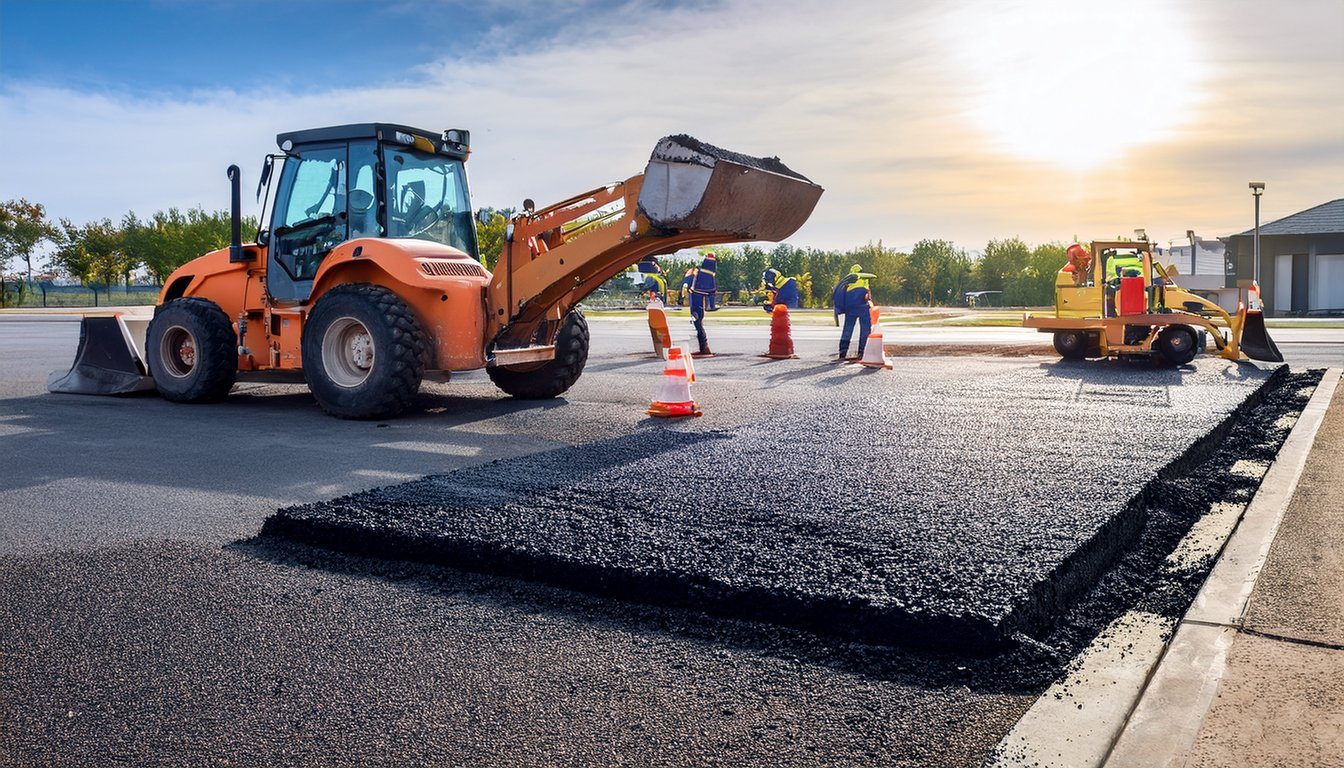
| Resurfacing | Widespread surface wear on a sound base | $2 to $7 per square foot | Angi |
| Mill and overlay | Grinding off the worn top layer and paving a new one | $2.50 to $4.50 per square foot | TruTec (industry blog) |
| Restriping | Faded or changed layout | $5 to $20 per parking space | Angi |
A few notes on reading those numbers. HomeGuide prices crack filling differently, at "$0.50 to $3.00 per square foot," and Pavemade puts resurfacing with a two-inch layer at "$2 to $2.50 per square FT," so the unit and the scope behind each number matter as much as the number. HomeGuide's remove-and-replace figure comes from driveways, and a lot that carries trucks may need a thicker repair section than a driveway does. And TruTec, a paving industry blog, notes that "A full replacement might be 2-3 times the initial cost of an overlay." Sealcoating is covered in our sealcoating guide, and new paving in our asphalt paving cost calculator .
Why waiting costs more
In our experience, pavement doesn't wear out on a straight line: it holds up for years, then goes downhill quickly once water gets through the surface and into the base. The Federal Highway Administration's 2000 report Pavement Preservation: Preserving Our Investment in Highways puts numbers on it for roads: "every dollar spent now on pavement preservation can save up to six dollars in the future," and "Repairing or rehabilitating a pavement costs six to eight times more than using preventive maintenance treatments." It also warns that "Placing a treatment on the road too late, meaning structural damage has already started to appear, will result in poor performance."
For a parking lot owner, that translates into a simple habit. In our experience, sealing cracks while they're still thin and patching potholes while they're small is what keeps a lot out of the full-depth and overlay columns of the table above.
Restoring and accessible parking
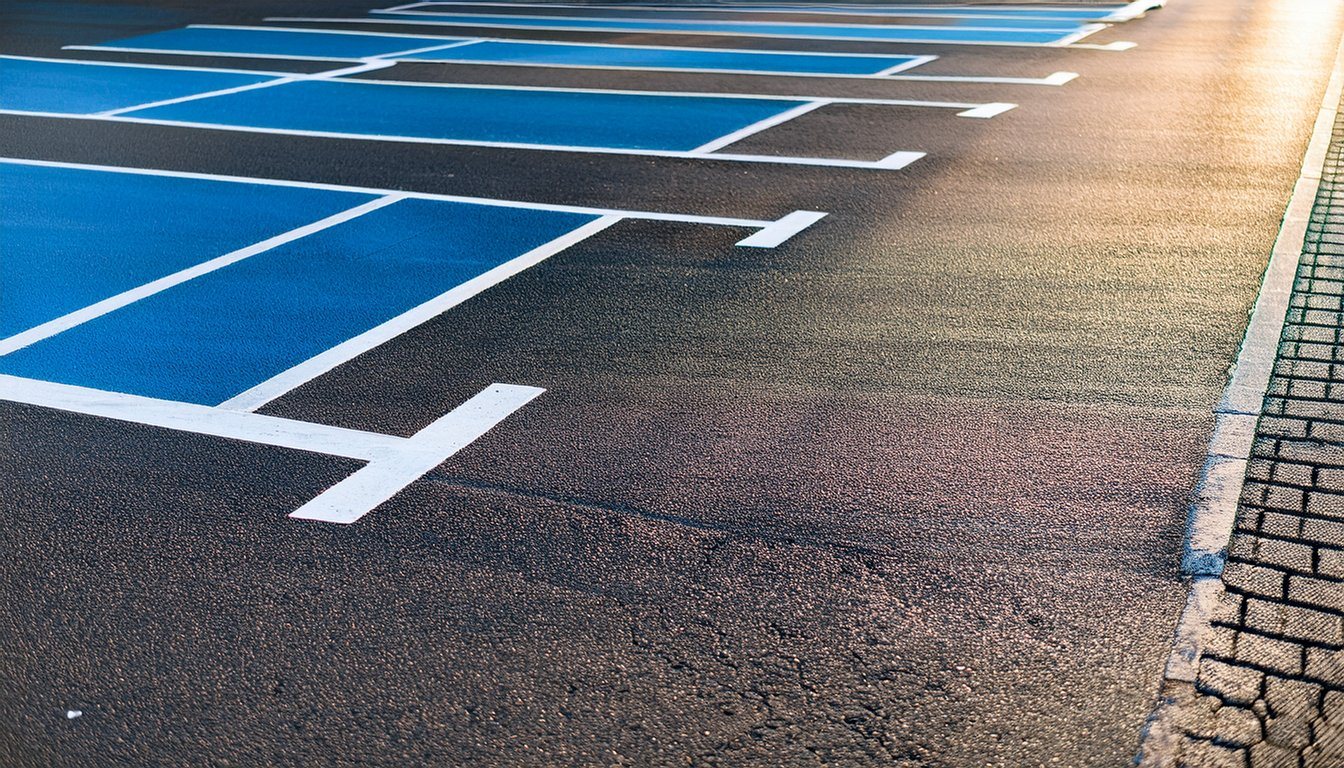
Restriping looks like the simplest item on the list, but it carries a legal obligation. The Justice Department's ADA business brief on restriping parking lots says: "When a business restripes a parking lot, it must provide accessible parking spaces as required by the ADA Standards for Accessible Design." It adds that businesses serving the public "have a continuing ADA obligation to remove barriers to access in existing parking lots when it is readily achievable to do so. Because restriping is relatively inexpensive, it is readily achievable in most cases." For the cost of an accessible ramp at an entrance, see our ADA ramp cost guide .
So when a lot is restriped, check the number, location and marking of accessible spaces against current requirements before the crew paints. Angi's striping cost guide lists handicap spaces at $25 to $50 each for striping. In our experience, California's own accessibility requirements add to the federal ones, so a designer or contractor familiar with them is worth involving on anything beyond a repaint of the existing layout.
What moves the price
- Quantities. Every repair is priced by measured quantity: linear feet of crack, square feet of patch or overlay, number of stalls.
- Minimums. HomeGuide's pothole figure includes $100 to $250 just to bring out the machinery and crew, which is why a single small repair costs more per unit than a batch.
- Patch depth. A full-depth patch that removes the base costs more than a surface patch, and may need drainage corrected underneath if water caused the failure.
- Keeping the business open. Traffic control, cones and working in sections so customers can still park add labor to the bid.
- Work at the street. In our experience, repairs at a driveway apron or anything in the public right of way can need a city permit, which adds cost and lead time.
Reading a repair bid
A good parking lot repair bid lists each repair with its quantity and unit: linear feet of crack sealing, square feet and depth of each patch, square feet and thickness of any overlay (and mill depth if the surface is being ground first), and the stall count for restriping, including accessible spaces. With bids broken out that way, you can compare them line by line and see which one priced a full-depth patch where another priced a skin patch over the same alligator cracking. Our guide to parking lot repair companies covers which licensed crew handles which damage. Medici Construction Group is one licensed option for parking lot repair and paving, holding California A, B and C-10 licenses under CSLB #1114433.
Frequently asked questions
How much does it cost to repair a parking lot?
It depends on the repair. Crack sealing runs about $1 to $3 per linear foot, resurfacing about $2 to $7 per square foot, and mill and overlay about $2.50 to $4.50 per square foot, according to published guides. Full-depth repairs cost more.
How much does parking lot crack sealing cost?
One paving contractor puts crack filling at $1 to $3 per linear foot. The total depends on how many feet of cracks the lot has, plus any minimum charge.
How much does it cost to fix a pothole in a parking lot?
HomeGuide puts pothole patching at $25 to $40 per pothole, plus $100 to $250 to bring out the crew and machinery. Potholes surrounded by alligator cracking usually need a larger full-depth patch.
How much does it cost to resurface a parking lot?
Angi lists parking lot resurfacing at $2 to $7 per square foot. Mill and overlay, which grinds off the worn top layer first, runs about $2.50 to $4.50 per square foot according to one industry blog.
Is it cheaper to patch or repave a parking lot?
Patching is cheaper when the damage is limited and the rest of the lot is sound. In our experience, when failures are widespread, repeated patching can cost more over time than an overlay or replacement.
Do I have to add ADA parking when I restripe?
The Justice Department says a business that restricts a parking lot must provide accessible parking spaces as required by the ADA Standards for Accessible Design. In California, state accessibility requirements also apply, so check both before restriping.
Who pays for parking lot repairs, the landlord or the tenant?
It depends on the lease. In our experience, many commercial leases pass parking lot upkeep through to tenants as common area maintenance charges, but the lease language decides who pays for what.
How often should a parking lot be repaired?
In our experience, a yearly inspection with crack sealing while cracks are small works well. The Federal Highway Administration notes that treatments applied after structural damage appear to perform poorly.