Two Los Angeles homeowners each want 400 more square feet. One builds out into the backyard, the other builds up. Angi's Los Angeles figures put building out at $160 to $400 per square foot and building up at $600 to $1,000 per square foot. For 400 square feet, that works out to roughly $64,000 to $160,000 for the first homeowner and $240,000 to $400,000 for the second. Same footage, up to six times the price.
That is why a single "average addition cost" is not much help. In LA, the type of addition, and how much floor area the City still allows on your lot, set the price more than any per-square-foot number. This guide covers costs by room and square foot, how to choose between addition types, the LA fees national guides skip, and how to compare bids.
Quick answers
- Average in Los Angeles: Angi puts it at $102,994, with most projects between $59,907 and $156,853.
- Per square foot in LA: $160 to $400 building out, $600 to $1,000 building up.
- Permit: yes. A room addition in the City of LA goes through LADBS plan check before a building permit is issued.
What a home addition costs in Los Angeles
Angi's Los Angeles page puts the average home addition at $102,994 and says the city's "high cost of living means a home addition will cost around twice the national average." Nationally, Angi's average is $51,000. By room:
| Addition type | Los Angeles (Angi LA) | National average (Angi) |
|---|---|---|
| Bathroom | $70,000 to $80,500 | $35,000 |
| Bedroom | $125,000 to $143,750 | $62,500 |
| Kitchen | $110,000 to $126,500 | $55,000 |
| Second story | $350,000 to $402,000 | $175,000 |
As a single-room benchmark, a 10-by-10 room addition runs about $25,000 if you build out and $80,000 if you build up. The 2025 Cost vs. Value report puts a midrange primary suite addition in the Los Angeles metro at $182,518 and an upscale one at $387,485.
Cost per square foot, and why it misleads
National guides quote wide per-square-foot ranges by type. HomeGuide lists $125 to $250 for a room addition, $85 to $200 for a bump-out, $200 to $500 for a second story, and $50 to $200 for a garage conversion. LA numbers run higher, as the table above shows. Weighing a new house instead? See our house construction cost guide.
Block Renovation calls cost per square foot "probably the most misleading number" in addition pricing, because two rooms with the same footprint can cost very different amounts depending on plumbing and mechanical systems. Its ranges: $150 to $350 per square foot for a basic room addition, $250 to $600+ for a bathroom addition, and $300 to $750+ for a kitchen addition. A bedroom or office is a "dry" room. A bathroom or kitchen is a "wet" one, and in our experience drains, supply lines, venting and extra circuits push its price up.
How to estimate your own addition
A rough estimate, the way a home addition cost calculator builds one, takes four steps:
- Footage times the right range. Pick the range for your type. For a 400-square-foot bedroom built out in LA, Angi's $160 to $400 per square foot gives $64,000 to $160,000.
- Add design and permits. Angi puts architect and design fees at $2,400 to $14,000 nationally, and LA permits at $180 to $1,600. In our experience, engineering and a survey come on top.
- Add site prep. Angi's LA page lists $3,000 to $10,000.
- Add a contingency and LA fees. In our experience, 10% to 15% covers most surprises found when walls open up. Above 500 square feet, add the school fee covered below.
Treat the result as a range to test bids against.
Build out, build up, bump out or convert: which to choose
In our experience, there are four ways to add space. The right one depends on your yard, your foundation, and whether the room needs plumbing. Building over the garage has its own cost drivers, covered in our guide to a second story over a garage.
Bump-out. A small extension of an existing room. HomeGuide puts bump-outs at $85 to $200 per square foot on average or $5,000 to $35,000 total, and says most extend 2 to 15 feet. They cost less because they often skip a new foundation and reuse nearby electrical and plumbing, with construction at 1 to 4 weeks. Our guide to framing an addition to an existing house explains how bump-outs and larger additions tie into the house.
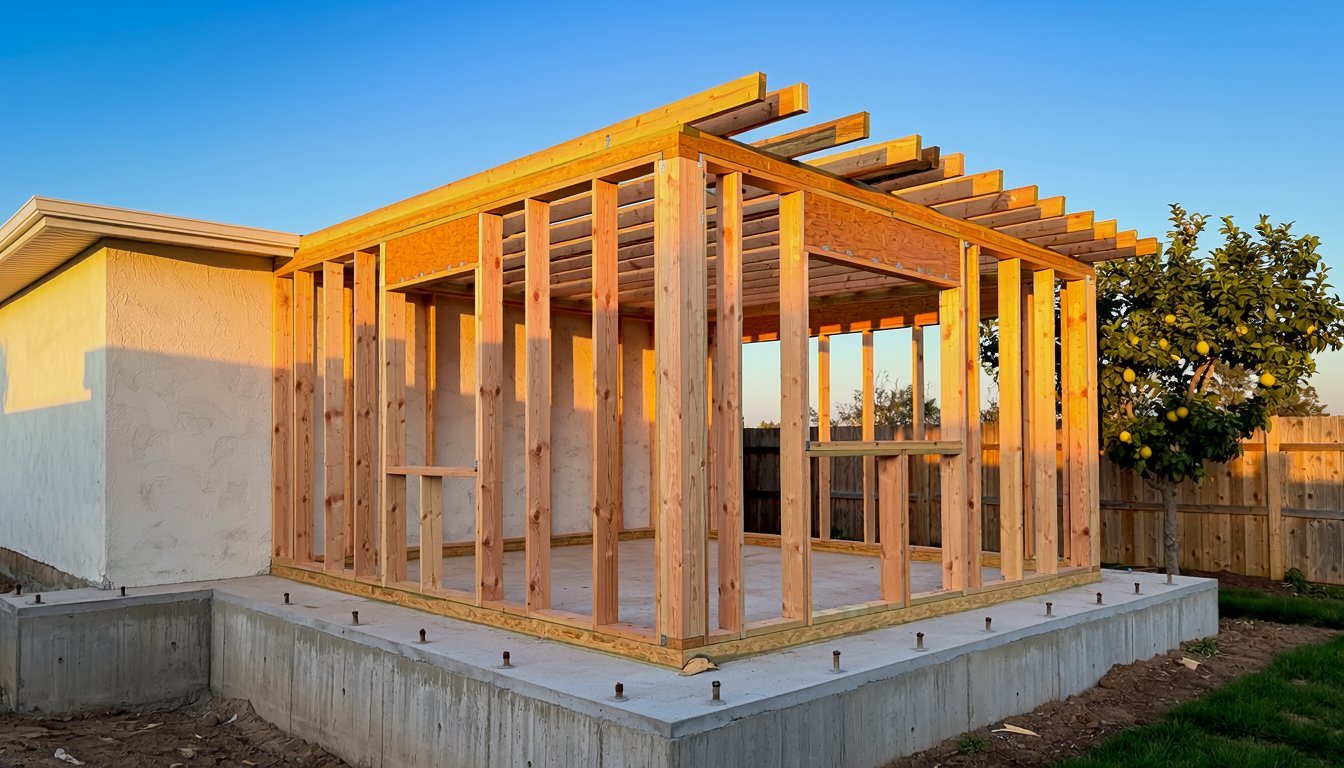
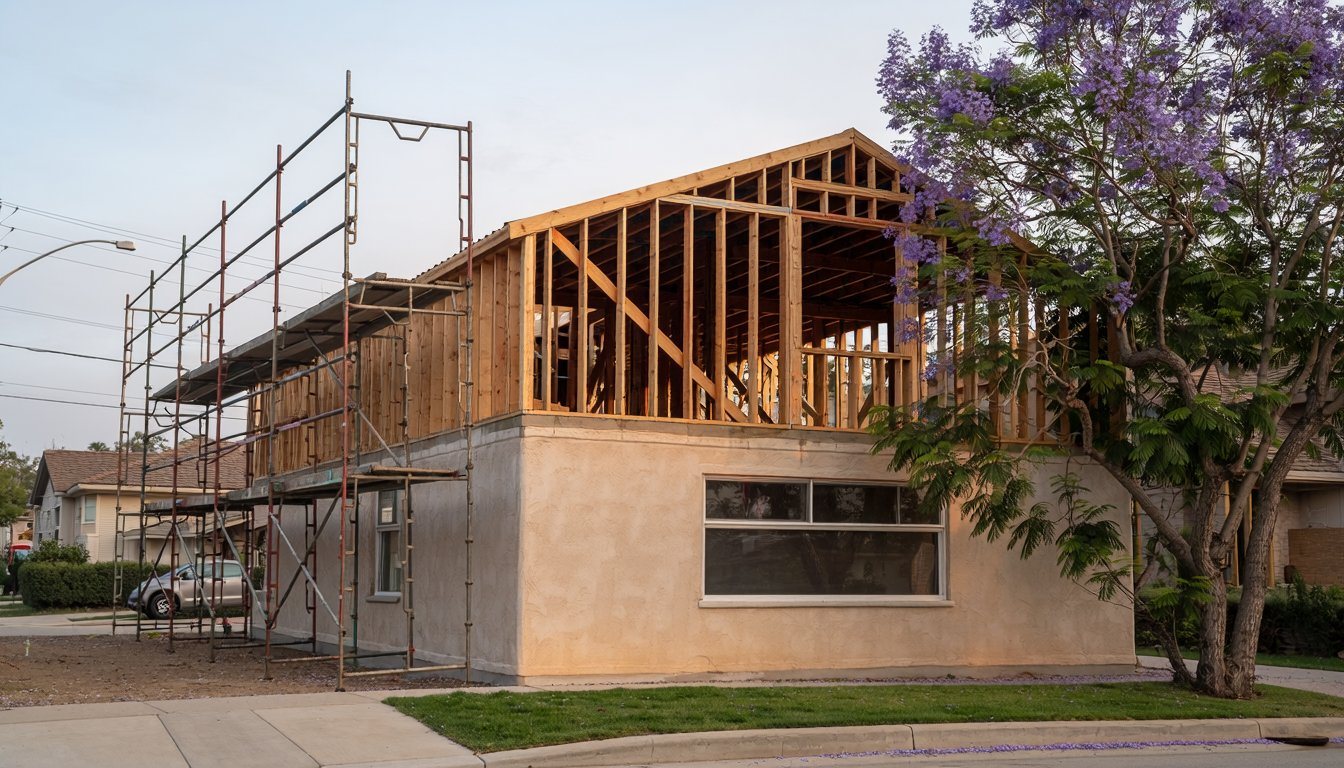
Build out. A new room on a new foundation, usually into the backyard or side yard. In our experience, setbacks and the floor-area limits covered below decide how far you can go, and it is the usual choice for a bedroom, family room or primary suite on a flat lot.
Build up. A second story or a room over the garage. It keeps your yard, but costs the most. HomeGuide warns that "many one-story homes do not have a strong enough foundation or footings for a second floor," and lists house lifting or full foundation replacement at $20,000 to $100,000. See our foundation repair cost guide, our second story addition cost guide and modular second story addition cost.
Convert existing space. Turning a garage or attic into living space. HomeGuide notes that converting basements, garages or attics costs less than building a new structure, and lists garage conversions at $50 to $200 per square foot. A unit with its own kitchen is an ADU; see our ADU construction cost guide.
What is the cheapest way to add on? Converting space you already have is usually cheapest, then a bump-out or a single-story "dry" room. Wet rooms and anything built on top of the house cost the most.
Where the money goes
Labor is the biggest single share. Angi's LA page puts it at 40% to 60% of your total project cost, with contractor and builder fees at 10% to 20% of the total price. Angi's national line items:
- Interior finishes: $30 to $300 per square foot, the widest range
- Building permits: $150 to $7,500, averaging $1,300
Costs people miss
- Heating and cooling. Bankrate says extending HVAC ductwork can cost over $3,000.
- Electrical capacity. A kitchen or heat pump can push an older home past its service size; see our electrical panel upgrade cost guide.
- Tying in and matching. In our experience, joining old and new roofs and matching stucco, flooring and paint is where loose bids grow most.
LA rules and fees that change the price
None of this shows up in a per-square-foot average, and some of it decides what you can build at all. To estimate the city's share, see our LADBS permit fee calculator guide.
Permits and plan check
A room addition in the City of Los Angeles needs LADBS plan check before the building permit is issued. On regular plan check, LADBS says plans are "reviewed and then returned within weeks depending on workload," and that "With 50% more of the plan check fee paid, the plan check review will be expedited." In our experience, corrections and resubmittals add more time than the first review. Our home addition plans guide covers the drawing set.
The floor-area cap and hillside rules
On single-family lots, the City's Baseline Mansionization Ordinance limits how big the whole house can be, not just the addition. The 2016 amendments were designed to "Reduce maximum Floor Area Ratio from 0.5 to 0.45, regardless of lot size" and to "Reduce the exemption for front attached garages to 200 square feet." If your house is near the cap, the addition you can build may be smaller than you want. On a hillside lot, ask City Planning which limits apply before paying for full plans. In our experience, hillside lots that need real grading also need a soils and geology report before LADBS approves plans, which HomeGuide prices at $1,000 to $5,000 for a geotechnical report.
Fees that catch people off guard
School fees above 500 square feet. California Education Code section 17620 lets school districts charge developer fees on additions "only if the resulting increase in assessable space exceeds 500 square feet." The statewide maximum residential rate was raised to $5.17 per square foot in January 2024, and the State Allocation Board raised it to $5.38 per square foot in January 2026. LAUSD collects the fee through its developer fee program, which notes that the State Allocation Board sets the rate every two years, so confirm the current figure there. At the cap, a 600-square-foot addition would owe about $3,100, while a 480-square-foot addition would owe nothing.
Sewerage Facilities Charge. The City charges a Sewerage Facilities Charge, which the Bureau of Engineering's S-permit fee guide describes as based on the flow and strength of the wastewater a property discharges. In our experience, adding bedrooms or bathrooms can bring it into play.
Property tax
Property tax goes up, but only on the new part. The Board of Equalization's handbook says "the newly constructed portion is assigned its own base year value" and "The remainder of the property, which did not undergo new construction, retains its existing base year value."
Is a home addition worth it in LA?
As a resale investment, usually not dollar for dollar. The 2025 Cost vs. Value report for the Los Angeles metro shows a midrange primary suite addition recouping 31.9% of its cost at sale, and an upscale one 17.7%. A midrange bathroom addition does better: $63,595 in cost and 57.6% recouped. HomeGuide is more optimistic, at about 60% to 80%. An addition pays off mainly in how you live, and in not having to buy a bigger house in LA.
How long it takes, living through it, and paying for it
Angi breaks the timeline into one to three months of planning and design, one to two months of pre-construction, and one to six months of construction. In LA, plan around plan check.
Can you stay in your house during an addition?
Usually, for a build-out or bump-out. In our experience, most families stay home while the new room is framed, and the disruption comes when the crew opens the existing wall. With a second story, in our experience, the roof comes off part of the house and many families move out for part of the job, and kitchen additions can mean weeks without a kitchen.
Paying for it
The Consumer Financial Protection Bureau describes a HELOC as "an 'open-end' line of credit that allows you to borrow repeatedly against your home equity," usually with a variable rate, and warns that "If you fall behind or can't repay the loan on schedule, you could lose your home." For an ADU, see our ADU financing guide.
Whatever you borrow, California limits what a contractor can take up front. CSLB says "The down payment cannot be more than $1,000 or 10 percent of the contract price, whichever is less." In most cases you also get a three-day right to cancel.
Getting bids you can compare
In our experience, every contractor prices different assumptions, and three things make bids comparable:
- Same drawings. Bid on the same plans and engineering, not a verbal description.
- Line items. Ask for foundation, framing, roofing, each trade, permits and fees listed separately, plus exclusions.
- Real allowances. A low bid with a small allowance for flooring, tile or fixtures will grow later. Compare the allowances, not just the total.
Still looking for builders? See how to find a contractor for a home addition.
Check any contractor's license before you sign. Our guide on how to check a California contractor's license walks through it. Medici Construction Group is one licensed option for home additions, holding California A, B and C-10 licenses under CSLB #1114433. Settle what you are building and how much floor area your lot allows before you compare prices. Still deciding? See our home addition ideas guide.
Frequently asked questions
How much does a home addition cost in Los Angeles?
Angi puts the LA average at $102,994, with a typical range of $59,907 to $156,853. Where you land depends on the type of addition. Building up, adding a kitchen or bathroom, and building on a hillside lot all push costs higher, while converting existing space costs less.
Is it cheaper to build up or build out?
Building out is usually cheaper. Angi's LA page puts building out at $160 to $400 per square foot and building up at $600 to $1,000, because a second story often needs foundation work and part of the roof removed. Building up makes sense when you have no yard to spare.
How much does it cost to add a room to a house?
In LA, Angi puts a 10-by-10 room at about $25,000 built out and $80,000 built up, and a bedroom addition at $125,000 to $143,750. Nationally, Angi's bedroom average is $62,500, so LA runs about double. Wet rooms and second stories cost more than dry rooms built out.
How much does a bathroom addition cost?
Angi puts a bathroom addition in LA at $70,000 to $80,500. The 2025 Cost vs. Value report lists a midrange bathroom addition in the LA metro at $63,595. In our experience, the drains, venting and supply lines are what make bathrooms costly per square foot.
What is the cheapest way to add on to a house?
Converting a garage or attic is usually cheapest, since HomeGuide notes that converting existing space costs less than new construction. A bump-out, at $85 to $200 per square foot per HomeGuide, is next, and a simple dry room on a flat lot follows.
Does an addition raise property taxes in California?
Yes, but only for the new part. Under the Board of Equalization's rules, the newly constructed portion gets its own base year value and the rest of the home keeps its existing one. Your existing assessment is not reset to current market value because you built an addition.
How long does a home addition take?
Angi says simpler additions take three to four months from planning to completion, and second stories six months to a year or more. In LA, plan check and any corrections can add weeks or months before construction starts, so budget for that.
Do I need a permit for a home addition in Los Angeles?
Yes. In the City of LA, an addition needs LADBS plan check and a building permit, and it must fit within the City's floor-area limits for your lot. Check those limits before paying for full plans, since they can cap the size of the addition.