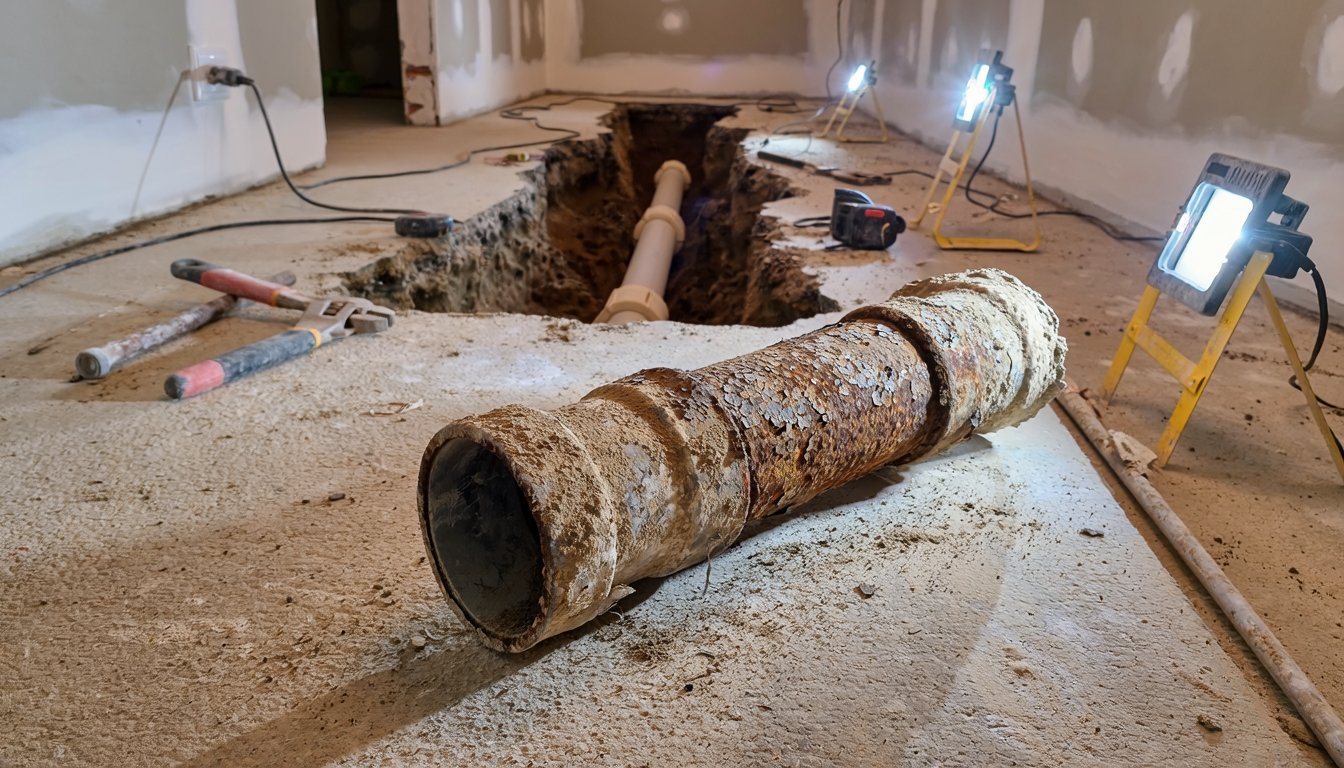
One national cost guide puts the typical cost to replace cast iron pipe at a few hundred dollars. The same guide puts replacing it under a concrete slab at $3,000 to $20,000. Both numbers are real. The gap between them is the whole story of what a cast iron sewer replacement costs: where the pipe runs, and how a crew gets to it, matters more than how many feet of it there are.
Quick answers
- The range is enormous: from a few hundred dollars for a short, exposed run to as much as $20,000 for work under a slab.
- Location drives it. Pipe in a crawl space or exposed in a basement is cheap to reach. Pipe under a slab or inside walls is not.
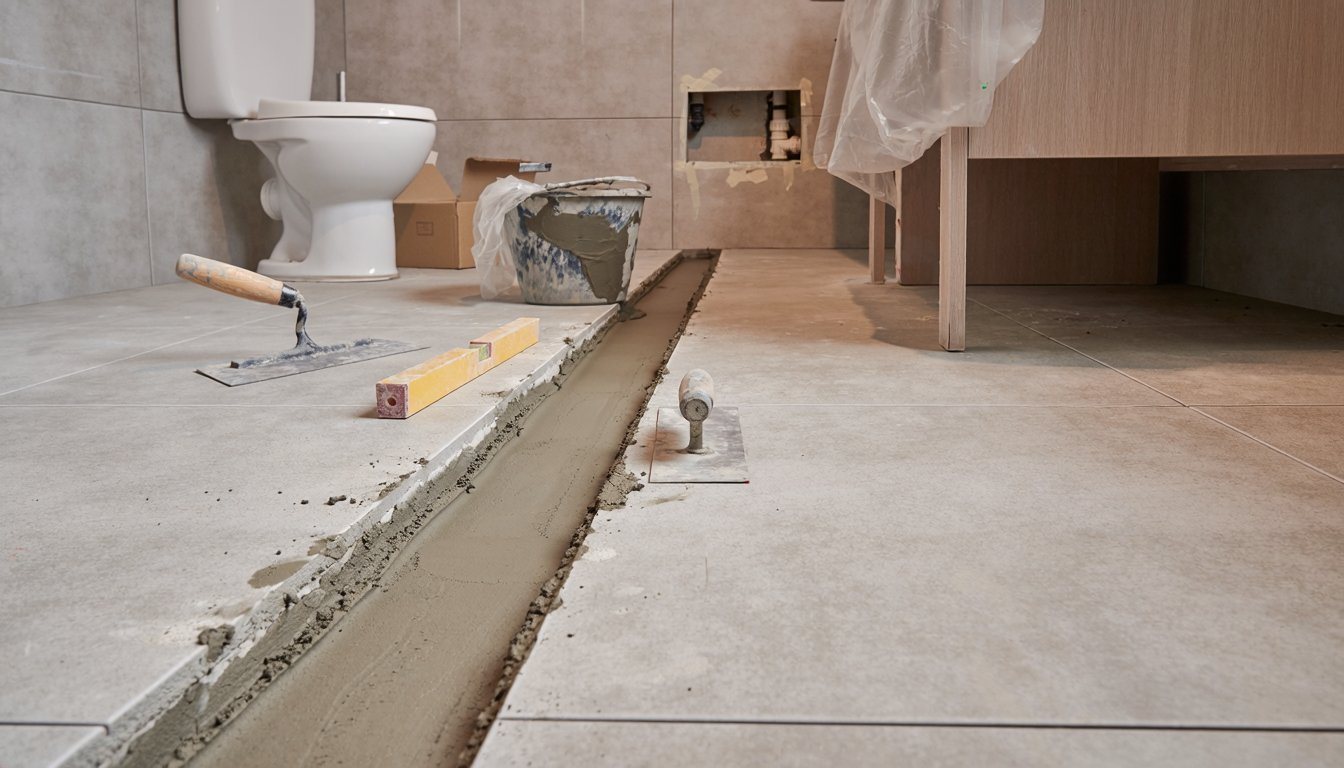
- Under a slab, you pay for access one of two ways: breaking through the floor from inside (cheaper for one spot, then flooring to replace) or tunneling from outside (more per foot, no interior mess).
- The pipe itself is often a small part of the bill. In our experience, access and restoration usually cost more than the pipe.
- For the yard lateral out to the street, see our sewer line replacement cost guide; for lining instead of replacing, see our sewer pipe lining cost guide.
Why the national average doesn't tell you much
Angi's cost guide says "the cost to replace cast iron pipes is $650, but homeowners typically spend anywhere from $375 and $900." That figure covers cast iron pipe replacement generally, not only the sewer line, and it describes a short, reachable run. It's a useful anchor for a small job and a misleading one for anything bigger.
The same guide breaks the cost out by where the pipe is, and that table tells a very different story. Replacement "under a slab: $3,000–$20,000" and for a "basement overhead sewer line: $8,000–$10,000." (Figures as retrieved in September 2026.) A homeowner reading only the headline average and then receiving a five-figure quote for under-slab work isn't necessarily being overcharged. They're looking at a different job.
Where your cast iron runs decides the price
Older homes often have cast iron in more than one place, and each location has its own cost profile. Figures below are Angi's where given; the other rows are described, not priced, because we found no reliable published figure for them.
| Where the pipe runs | What drives the cost | Published figure |
|---|---|---|
| Exposed, or in a crawl space | Easy access; mostly pipe and labor | Closest to the headline average |
| Sewer trap | Excavation to reach the trap | $1,500–$3,000 |
| Basement, overhead | Length of the run, supports, working overhead | $8,000–$10,000 |
| Under a slab | Breaking the floor or tunneling, then restoration | $3,000–$20,000 |
| Inside walls (vertical stacks) | Opening and patching walls, working around finishes | No reliable published figure; quote-dependent |
| Yard, out to the street | Trenching or trenchless work on the lateral | See our sewer line replacement cost guide |
The practical takeaway: before comparing quotes, find out which of these locations each quote actually covers. Two "cast iron replacement" quotes can differ by thousands of dollars simply because one covers the under-slab section and the other stops at the crawl space.
Under the slab: break through or tunnel
When cast iron runs beneath a slab foundation, the cost depends mostly on how the crew reaches it. There are two ways, and they trade upfront cost against disruption. The figures here come from a foundation and tunneling contractor, so treat them as one company's published ranges rather than a national survey.
Breaking through from inside. Cutting the floor directly above the pipe can be the cheaper route when the problem is in one spot. The same contractor estimates it as "less expensive (estimated at $300 to $500 total) if there's only one isolated leak" (a figure given for a slab leak repair, so treat it as a floor, not a replacement price), but lists "higher extra costs with flooring damage and replacement" as the main downside. For a longer run, the flooring bill can quickly erase the savings, especially under tile or hardwood.
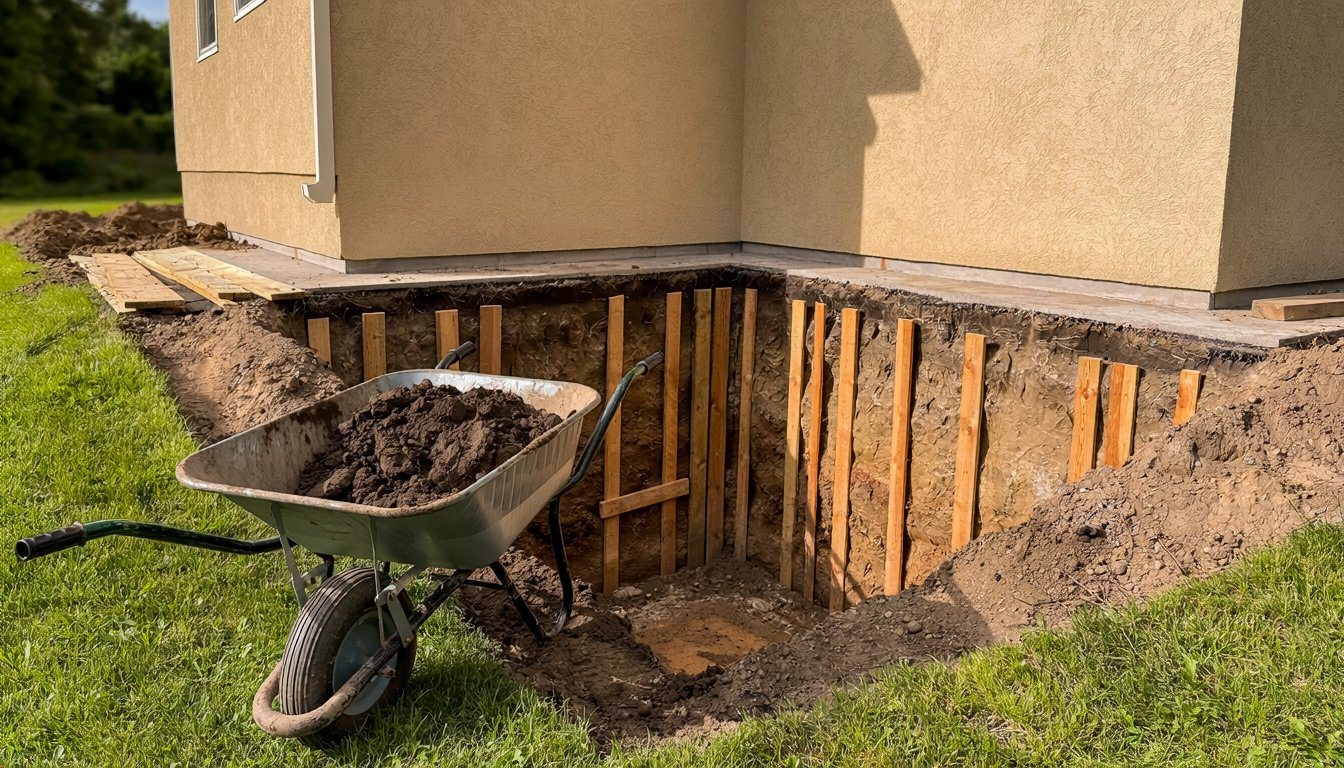
Tunneling from outside. Digging under the slab from the exterior avoids opening the floor. The contractor's pricing page says to "[e]xpect tunneling costs to range from $200 to $500 per foot," and adds an important caveat: "this only covers the tunneling. Plumbing repairs are billed separately by your plumber." It also notes tunneling "takes longer depending on the location and number of leaks (1-5 days)" and that "many plumbers don't do tunneling, so you need another contractor involved."
In our experience, the choice usually comes down to how much pipe is involved and what's on top of it. One spot under an inexpensive floor favors breaking through; a long run under finished flooring, or a household that can't give up a kitchen or bathroom for days, favors tunneling.
The costs outside the pipe itself
A quote that only prices pipe and labor is leaving things out. On most cast iron replacements, several other items belong in the total:
- Floor and wall restoration. Whatever gets cut open has to be closed and finished again, from concrete patching to new tile or drywall and paint. Ask whether it's included or billed separately.
- Permits and inspection. Replacing drain and sewer piping typically requires a plumbing permit and inspection; requirements and fees vary by jurisdiction.
- Camera inspection before and after. A video inspection shows what condition the pipe is actually in and confirms the new work afterward. Our sewer camera inspection guide covers what that involves.
- Time without plumbing. Not a line item, but a real cost if the work takes a bathroom or kitchen out of service for days.
Worked example: one bathroom drain under a slab
Here's an illustration using the tunneling contractor's own published rate, which it states as "$650 to start an under-slab tunnel, and $400 per foot after that." Say a bathroom drain needs 10 feet of tunneling to reach.
| Reading of the rate | Math | Tunneling cost |
|---|---|---|
| $650 covers setup; all 10 feet billed at $400 | $650 + (10 × $400) | $4,650 |
| $650 includes the first foot; 9 more at $400 | $650 + (9 × $400) | $4,250 |
That works out to roughly $425 to $465 per foot, inside the $200 to $500 per foot range quoted above. (The same contractor notes its per-foot price goes up after 20 feet, and another of its pages cites $300 to $500 per foot, so its own figures vary.) Remember that this is tunneling alone. The plumber's work to remove the cast iron and install new pipe, permits, and any restoration are added on top. This is an illustration built from one company's published rate, not a quote; your own job depends on the depth, soil, length, and who's doing it.
Replace or line?
Replacement isn't the only option for old cast iron. If the pipe is still structurally intact, lining it from the inside can avoid opening floors at all, though heavily scaled cast iron often needs descaling first. Our sewer pipe lining cost guide covers what lining costs, our cast iron descaling cost guide covers the prep step, our guide to cast iron pipe lining covers what drives lining cost for cast iron specifically, and our trenchless sewer repair cost guide compares lining, bursting and spot repair. Pricing a single broken section is a separate question from replacing a whole run, and a camera inspection is what tells you which one you're actually facing. If a camera found a crack and you are not sure what it means for the rest of the line, see cracked cast iron sewer pipe. If you replace, our cast iron to PVC guide covers where the new pipe should stop and how the joint should be made. If only one spot is damaged, our cast iron pipe repair guide covers when a repair is enough.
How to compare cast iron replacement quotes
Because location and access drive the price, a useful quote spells out:
- Exactly which runs are being replaced (under slab, walls, crawl space, yard) and their approximate lengths
- The access method for each run: breaking through, tunneling, or opening walls
- Who does the tunneling and who does the plumbing, if they're different companies, and whether both are in the price
- What restoration is included: concrete patch only, or finished floors and walls
- Permit and inspection, and who pulls the permit
- Camera inspection footage before the work and after it
- The replacement pipe material, named in writing
A quote missing several of these isn't necessarily wrong, but it's hard to compare against one that includes them. Medici Construction Group is one licensed option for sewer and drain replacement, holding California A, B and C-10 licenses under CSLB #1114433.
Frequently asked questions
How much does it cost to replace cast iron sewer pipe?
Anywhere from a few hundred dollars for a short, exposed run to as much as $20,000 under a slab. Angi's figures range from a typical $375 to $900 for small jobs up to $3,000 to $20,000 for under-slab work. Where the pipe runs matters more than its length.
How much does it cost to replace cast iron pipe under a slab?
Angi puts it at $3,000 to $20,000. The access method is a big part of that: one tunneling contractor quotes $200 to $500 per foot for tunneling alone, with plumbing billed separately, while breaking through the floor can be cheaper for one spot but adds flooring replacement.
Is tunneling under the slab worth the extra cost?
It often is for longer runs under finished flooring, or when you can't lose a kitchen or bathroom for days. For one isolated spot under an inexpensive floor, breaking through is usually cheaper.
How much does it cost to replace cast iron sewer pipe in a basement?
Angi puts a basement overhead sewer line at $8,000 to $10,000. Pipe that's exposed and easy to reach costs less; pipe buried under a basement slab is likely closer to the under-slab range.
Is it cheaper to line or replace cast iron pipe?
Lining often avoids the demolition and restoration that make replacement expensive, but it generally requires pipe that's still structurally sound. Our sewer pipe lining cost guide covers lining prices.
Does homeowners insurance cover cast iron pipe replacement?
Coverage depends on the policy and on what caused the damage. Our sewer line replacement cost guide covers what standard policies typically exclude; check your own policy and ask your insurer before work starts.