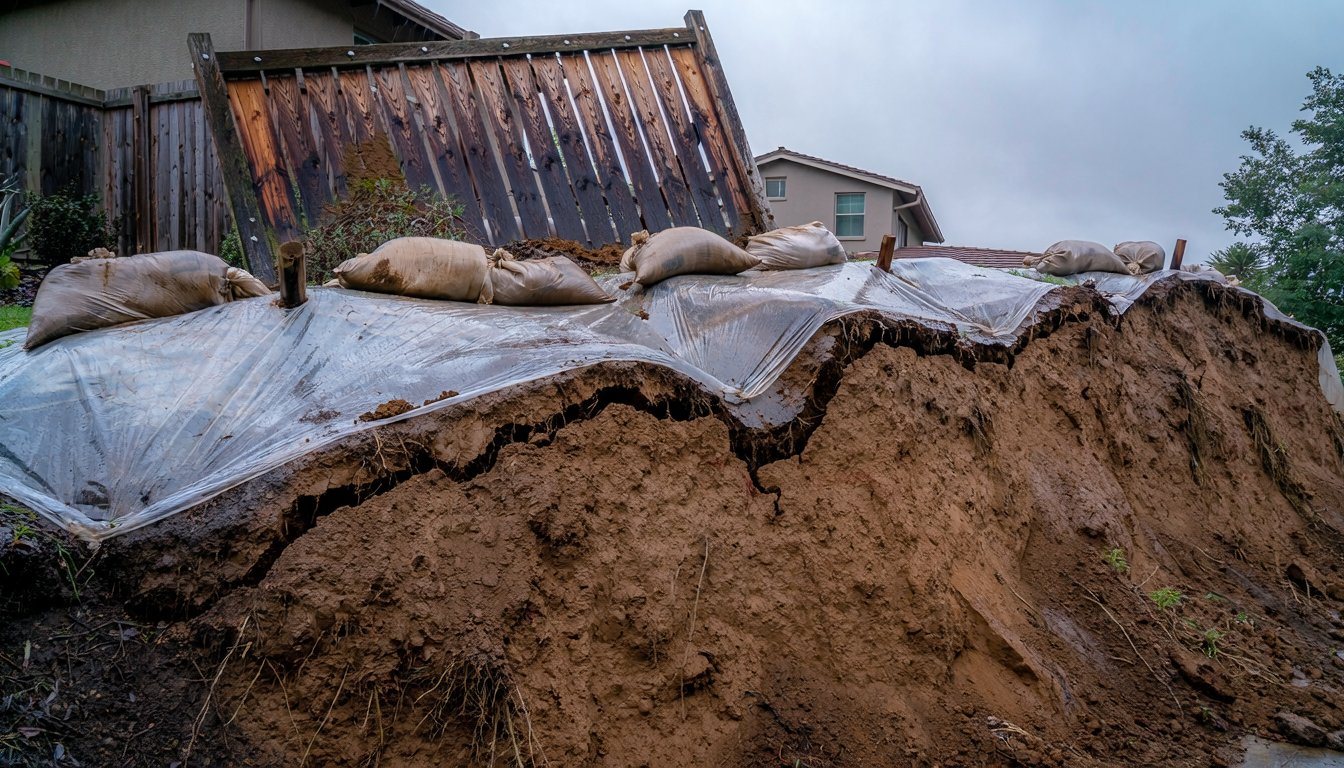
It usually starts after a week of rain. A crack opens along the top of the slope, a fence post leans, or a patio pulls away from the house. In March 2024, a slide in Sherman Oaks showed how far it can go: "A landslide destroyed one home and damaged three others in Sherman Oaks," and "Officials believe the saturated soil around these homes played a factor in the landslide."
In our experience, once the ground itself is moving, erosion tips like plants and straw wattles won't help, and a new wall at the bottom may not help either. Our guide to stopping slope erosion explains how to tell the two problems apart. This guide is for the harder case: what to do in the first days, the City deadlines that start once LADBS gets involved, how hillsides are stabilized, what it costs and what insurance will and won't cover.
Quick answers
- Danger now: call 911. Damage but no immediate threat: call 311 in the City of LA.
- Temporary steps: keep water off the slope and out of the cracks. Don't dig, fill or build anything yet.
- City deadlines: after an LADBS slope-failure notice, contact LADBS within 60 days and finish the repair within 180 days.
- Who designs the fix: a licensed consultant with geotechnical engineering and engineering geology expertise, required by LADBS.
- First cost: a geotechnical report typically runs about $1,000 to $5,000.
- Insurance: standard homeowners policies exclude landslides. An earthquake policy covers a slide only if an earthquake caused it.
The first 48 hours: safety and who to call
LADBS spells out the first call in its slope failure bulletin: "When a damaging landslide occurs on your property, call 311 to report the damage unless it is imminent threat, in which case call 911." If you live in unincorporated LA County, such as Altadena or Topanga, your building department is LA County Public Works Building and Safety, not LADBS.
Don't wait for permission to leave. Ready LA County tells hillside residents: "You also do not need to wait to be told to evacuate if you feel there is a risk to your safety."
While you wait for an engineer, the goal is to keep more water out of the ground. The City of Monterey Park's hillside guidance tells residents to "Use sandbags and plastic to help prevent flooding or channeling water away from structures," and adds "make sure your slope drains are cleaned and clear of debris that would obstruct water flow."
In our experience, these are the mistakes that make a moving slope worse:
- Dumping soil or debris at the top of the slope, which adds weight where it hurts most.
- Digging into the bottom (the toe) of the slope, which removes the support holding it back.
- Running sprinklers or letting downspouts discharge onto the slope.
- Hiring someone to build a wall before anyone knows how deep the slide goes.
Take dated photos of every crack with a tape measure in the frame. They show whether the slope is still moving, and they help the engineer and your insurer.
Is it moving, and how deep?
Ready LA County's list of warning signs is a good starting point: "Look for geological changes near your home, such as cracked soil, bulging slopes, new holes on hillsides, or muddy waters." In our experience, other clues include doors and windows that suddenly stick, new cracks in walls or pavement, and fences or trees that tilt.
Slopes don't all move the same way. The City of Rancho Palos Verdes, home to the Portuguese Bend landslide complex, says ground there has been measured to "move at rates between hundredths of an inch per year and tens of feet per year." A slow creep and a sudden slide need very different responses.
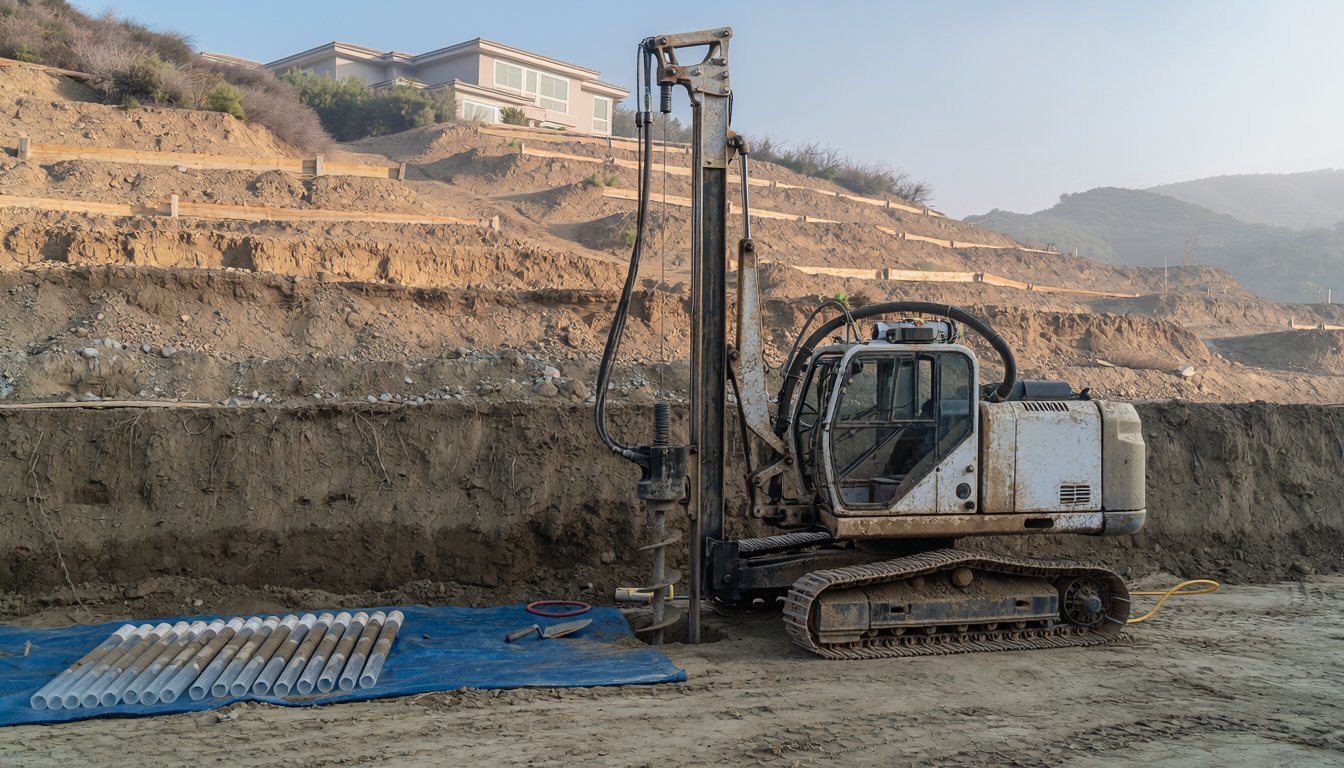
The most important question is how deep the movement goes. LADBS's slope stability bulletin requires the engineer to address "deep-seated and surficial stability evaluation under static load conditions." In our experience, a surface slump in the top few feet of soil can often be fixed with drainage and regrading, while a slide sitting on a deeper failure surface won't be stopped by a wall at the bottom of the hill; the fix has to reach below the moving mass. That's why the engineer's borings come before any design. Our retaining wall design guide covers what a wall can and can't hold back.
The LA rules: tags, notices and the 180-day clock
After a slide, inspectors may post the property. LADBS explains: "Properties and/or structures are Red tagged if there is an imminent hazard to the entire property or structure. Yellow tags are placed when only part of the property or structure presents a hazard." In Sherman Oaks, "two homes were red-tagged and a third was yellow-tagged."
Then the clock starts. According to the same bulletin, "The LADBS will send the owner a notification letter to inform the owner about the failure. The Los Angeles Municipal Code (LAMC) Section 91.7005.7 requires that all slope failures are repaired within 180 days of the notice." It also says to contact LADBS "within 60 days of receipt, to confirm its receipt and notify the LADBS regarding the plan for mitigating the slope failure." LAMC Section 91.7005.7 sets that 180-day window, and the notice can specify a shorter one.
In our experience, 180 days is tight once you add the engineer's investigation, design and plan check, so the 60-day call matters. Use it to tell LADBS who your consultant is and when you expect a report.
Who can design the repair is set too: "the property owner will need to secure the services of a licensed consultant having expertise in geotechnical engineering, engineering geology and materials testing." LADBS's stability bulletin adds that a stability evaluation "will be required for cut, fill and natural slopes whose gradient exceeds two horizontal to one vertical (2:1)."
Two other maps can shape the review:
- Seismic Hazard Zones. The California Geological Survey defines these as areas "prone to liquefaction (failure of water-saturated soil) and earthquake-induced landslides," and says the state's Seismic Hazards Mapping Act "requires site-specific geotechnical investigations be conducted identifying the hazard and formulating mitigation measures prior to permitting most developments designed for human occupancy within the Zones of Required Investigation."
- County hillside rules. In unincorporated areas, LA County's Hillside Management Area ordinance applies to land with natural slopes of 25 percent or more.
Our erosion guide covers when ordinary grading work on a slope needs a permit.
How hillsides are stabilized
In our experience, nearly every fix starts with water, because saturated soil is heavier and weaker. The University of Kentucky's highway knowledge portal describes one common tool: "Horizontal drains are a method of removing groundwater within a slide mass." Closer to the surface, a curtain drain can intercept water moving downslope through the soil before it reaches a wall or house.
From there, the options depend on depth, space and access:
- Regrading. The same portal says flattening slopes and reducing slope height "are common methods of repairing slopes if adequate right of way, fill materials, or waste areas for excavated materials are available." In our experience, that kind of room is rare on a small LA hillside lot.
- Tieback and anchored walls. The portal describes anchored walls this way: "These walls are tied back into the slope using an anchoring system made of steel tendons, cable anchors, strand anchors, deadman anchors, or many other materials." The Federal Highway Administration notes that "Ground anchors are often used in combination with walls, horizontal beams, or concrete blocks to stabilize slopes and landslides."
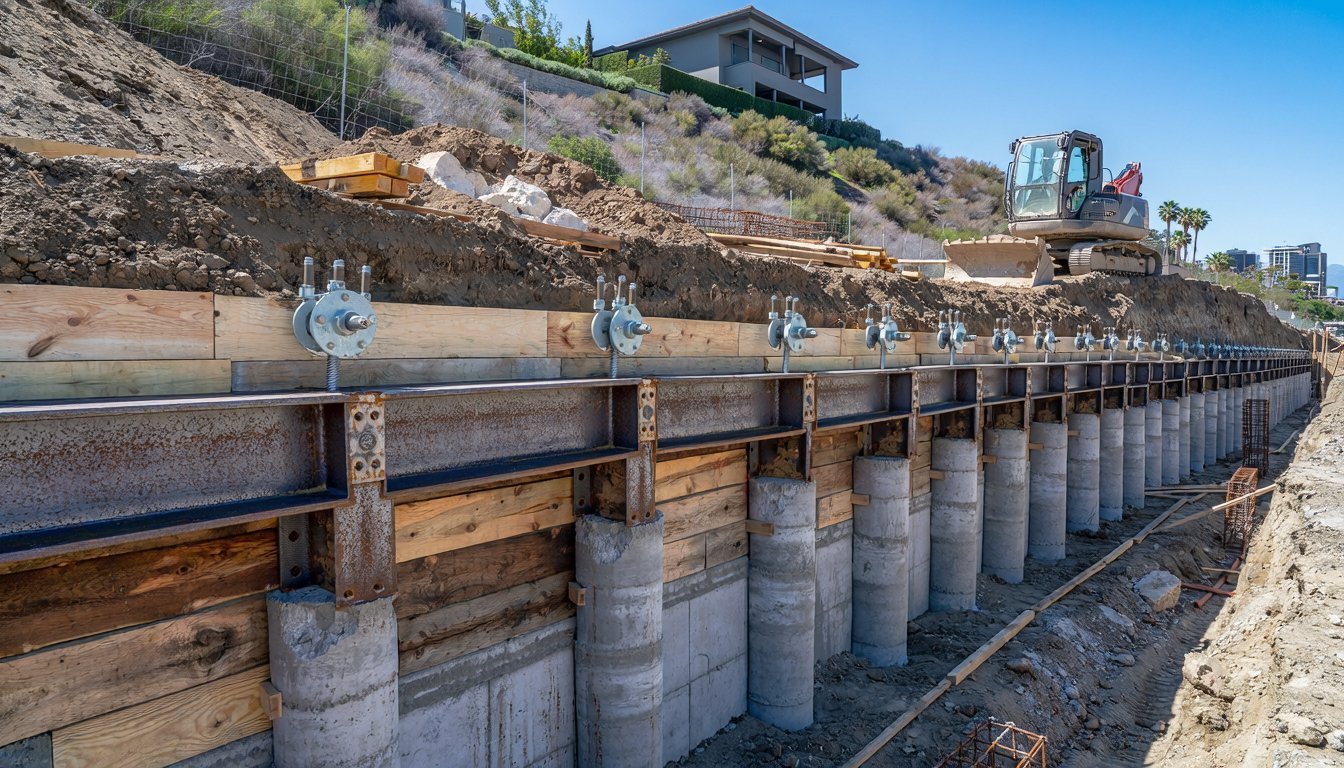
- Soldier piles and caissons. In our experience, the most common residential repair in the LA hills is a row of drilled concrete piles set below the failure surface, often with lagging between them and tiebacks at the top.
- Reinforced soil. Geosynthetic layers can rebuild a slope face, but "Careful design work is needed to determine the proper length, spacing, and strength of the geosynthetic."
In our experience, most LA repairs combine two or more of these, usually drainage plus a structural element. Our drainage plan guide explains how site water gets designed and approved. If your project involves new, planned earthwork rather than repairing an active failure, our grading plan guide covers those separate permit and engineering thresholds. (The same wall system is used to shore excavations on new hillside builds; see our guide to retaining walls in hillside construction.)
What hillside stabilization costs
The first bill is the investigation. Angi says "On average, a geotechnical report costs between $1,000 and $5,000, with most homeowners spending an average of $2,700." HomeAdvisor lists "$100 to $250 per hour for fieldwork, sampling, and on-site consultation." In our experience, a slide investigation with several deep borings on a steep lot lands at or above the top of those ranges.
The repair varies far more. Fixr puts soldier pile (I-beam) walls at "$35 to $150 per sq.ft." In our experience, total LA landslide repairs run from tens of thousands of dollars for a shallow slump with drainage to several hundred thousand for deep piles and tiebacks with hard access. Our retaining wall cost guide covers wall pricing in more detail.
In our experience, waiting rarely saves money. Rancho Palos Verdes says it spends "about a half million dollars per year" just to keep a road open through its active slide area. On a single lot, in our experience, each wet season a slope keeps moving usually makes the eventual repair bigger.
Will insurance pay?
Usually not. The Insurance Information Institute says "A landslide is considered an 'earth movement' event so, like an earthquake, it is excluded from standard homeowners and business insurance policies."
Flood insurance is narrower than many owners expect. The III notes that "Mudflow is covered by flood insurance, which is available from FEMA's National Flood Insurance Program (NFIP) and some private insurance companies." But FEMA's mudflow fact sheet separates mudflow from "landslide, slope failure, or a saturated soil mass moving by liquidity down a slope," and says the flood policy "does not insure earth movement, even if the earth movement is caused by flood."
An earthquake policy is narrow too. The California Earthquake Authority's sample homeowners policy covers "loss to covered property arising out of a seismically-induced landslide if that landslide is induced by, and would not have occurred in the absence of, an earthquake." A slide caused by rain doesn't qualify. The III notes you can buy a "Difference in Conditions" policy, which "typically offers all-in-one coverage for landslides, mudflows, earthquakes, and floods."
In our experience, it's still worth calling your agent and filing a claim, because damage from a burst pipe or other covered cause can be part of the story. If the slope that failed belongs to a neighbor, or yours damaged theirs, talk to a real estate attorney before either side signs anything or starts work.
Choosing who fixes it
The order matters. Hire the geotechnical engineer and engineering geologist first, then let their report drive the design, then bring in a contractor to build it. In our experience, a contractor who quotes a wall before seeing a geotechnical report is guessing. Questions worth asking:
- Has a geotechnical engineer and engineering geologist signed off on the design?
- How does the repair reach below the failure surface the report identified?
- What drainage is included, and where does the water go?
- How will equipment get onto the slope, and what does access add to the price?
- Who handles plan check and the LADBS deadline?
When you're ready to hire, check the license first; our guide to checking a California contractor license walks through it. Medici Construction Group is one licensed option for hillside stabilization, holding California A, B and C-10 licenses under CSLB #1114433. Whoever you hire, keep the engineer involved through construction, since they're the one who has to confirm the repair was built as designed.
Frequently asked questions
What is hillside stabilization?
Engineered work that stops a slope from moving, usually a mix of drainage, regrading and structural elements such as drilled piles, tieback walls or reinforced soil, designed from a geotechnical investigation.
What should I do if my hillside is moving?
Get people out of harm's way, call 911 if there's immediate danger or 311 in the City of LA to report damage, keep water off the slope with plastic and clear drains, photograph the cracks and call a geotechnical engineer before any contractor.
Who do I call about a landslide in Los Angeles?
In the City of LA, LADBS says to call 311 to report landslide damage, or 911 if there's an imminent threat. In unincorporated areas, contact LA County Building and Safety.
How long do I have to repair a slope failure in LA?
After an LADBS slope-failure notice, you're expected to contact LADBS within 60 days with your plan, and the code requires the repair within 180 days of the notice unless a shorter period is set.
Do I need a geotechnical engineer to fix a slope?
Yes. LADBS requires a licensed consultant with expertise in geotechnical engineering, engineering geology and materials testing to repair a slope failure.
How much does it cost to stabilize a hillside?
A geotechnical report averages about $2,700 nationally, with most between $1,000 and $5,000. In our experience, LA repairs range from tens of thousands of dollars for shallow slumps to several hundred thousand for deep piles and tiebacks.
Does homeowners insurance cover landslides?
Generally no. Standard homeowners policies exclude earth movement, flood insurance excludes landslides, and a CEA earthquake policy covers a landslide only if an earthquake caused it.
What are the warning signs of a landslide?
Cracked soil, bulging slopes, new holes on hillsides and muddy water, plus sticking doors and windows, new cracks in walls or paving, and tilting fences or trees.