In our experience, the most common curtain drain story starts with a drain in the wrong place. A lawn stays soggy below a slope, so someone digs a French drain right through the wet spot. It fills and drains, and the lawn stays wet, because the water was never collecting there. It was arriving underground, moving downhill through the soil from somewhere above. The trench was built well. It was just catching the end of the problem instead of the start.
That's the whole difference between a curtain drain and a French drain. The trench can be identical. What changes is where it goes, which way it runs, and how deep it reaches.
Quick answers
- What it is: a curtain drain is a gravel trench with a perforated pipe, placed uphill of the area you want dry and run across the slope, so it intercepts groundwater moving through the soil before it gets there.
- What it's used for: wet yards and slopes below higher ground, seeps, and protecting a structure or a septic field from water moving downhill underground.
- Versus a French drain: same construction, different placement and job.
- What decides it: whether the water is arriving through the soil from upslope or collecting in place.
What a curtain drain is
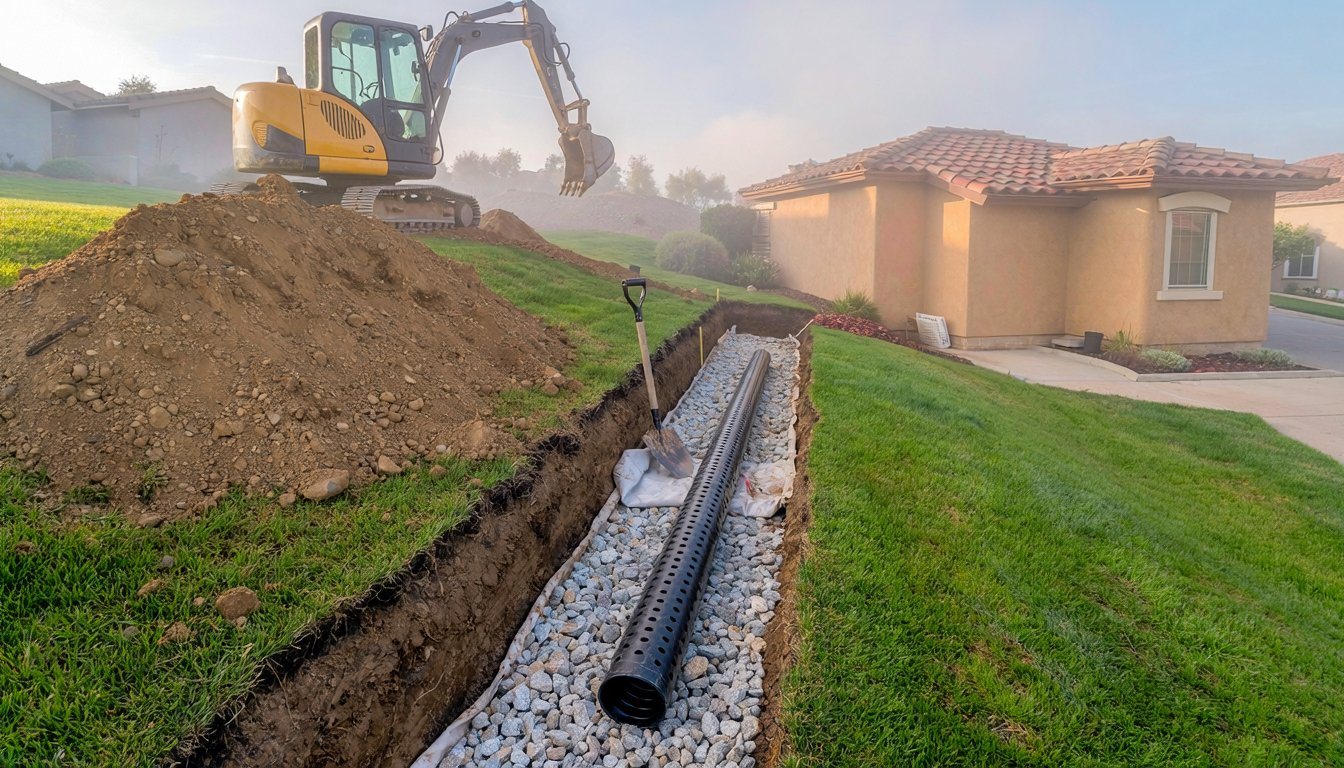
The names overlap because the build is the same. Oklahoma's Department of Environmental Quality puts it plainly: "A subsurface drain, commonly referred to as a French or curtain drain, is a tool used to protect groundwater and subsurface septic systems." Missouri's septic owner's manual describes the construction: "A typical curtain drain consists of a sloped trench filled with gravel with a perforated drainage pipe near the bottom" of the trench.
Many of the clearest published rules for curtain drains come from septic regulators, because the drains are a standard tool for keeping groundwater out of a septic drainfield. Missouri says curtain drains should be located to "maximize the groundwater intercepted" before it reaches the treatment area. Those septic-site rules aren't yard standards, but they show how the drain is meant to work. In our experience, most Los Angeles homes are on sewer, so the same idea shows up here protecting yards, slabs, walls and slopes instead of drainfields.
Hillside lots in Los Angeles
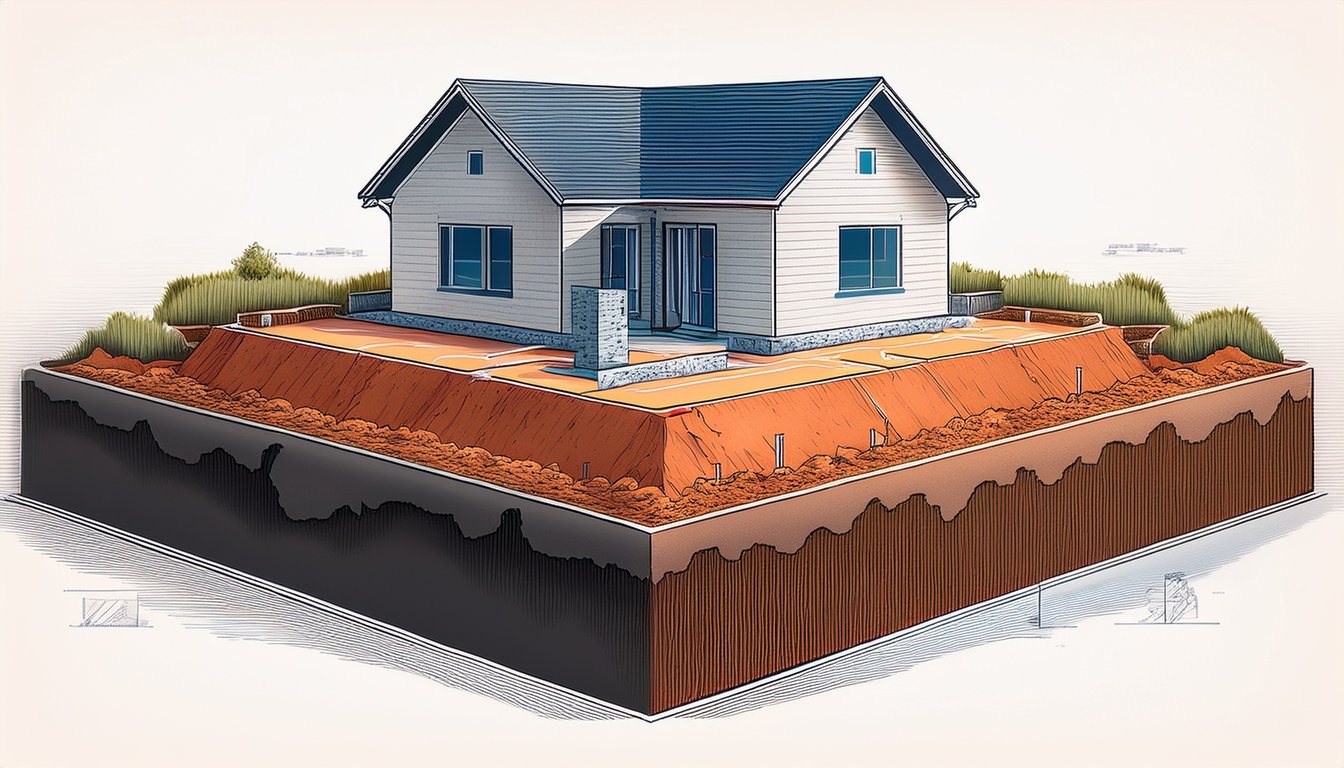
Hillside lots are where the curtain drain earns its name. Water soaks in on higher ground and moves downhill through the soil, and in our experience it often rides on a denser layer, such as clay or bedrock, until something interrupts it. That's where it shows up: a wet band across a lawn, a seep at the face of a cut, or dampness leaking through a retaining wall.
In our experience, the fix belongs upslope of where the water appears, not at the wet spot itself. If water is weeping out of a cut or a retaining wall face, the interception point is above the cut or behind the wall, where the drain can catch the water before it reaches the face.
Engineered grading already accounts for this. LA County's grading guidelines say "Subdrains shall be provided under all fills placed in natural drainage courses and in other locations where seepage is evident" unless the soils engineer or engineering geologist recommends otherwise, a rule written for engineered grading. On an existing slope, a deep trench can affect stability, so in our experience it's a job for a soils or geotechnical engineer before it's a job for a shovel. A curtain drain also has limits there. In our experience, it handles water moving through the soil; it doesn't fix surface runoff pouring over the top, and it isn't a substitute for a retaining wall or other structural repair where the ground itself is moving. Our guides to hillside stabilization and stopping slope erosion cover the slope side of the problem.
Curtain drain diagram, in words
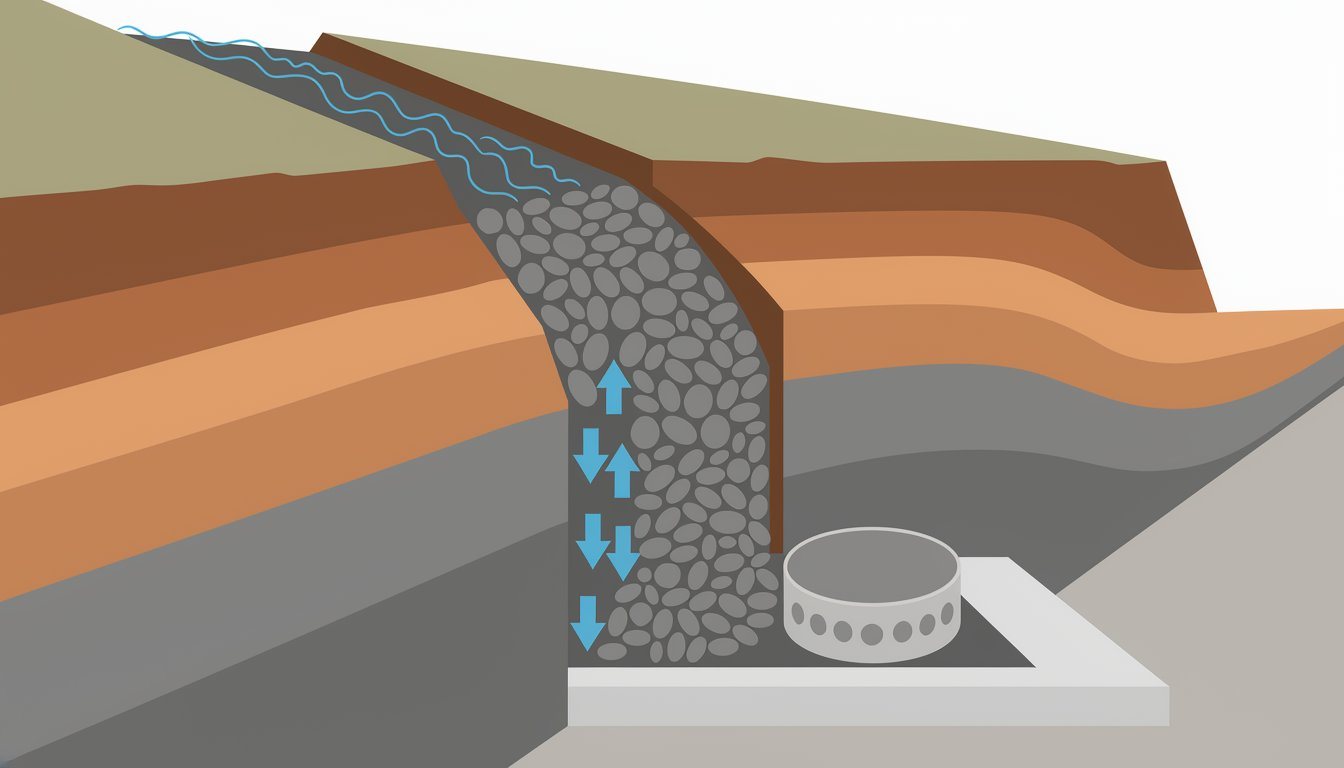
Picture a cross-section cut straight down the slope, uphill on the left and the area you're protecting on the right:
- Uphill ground: where rain soaks in and starts moving downslope through the soil.
- The trench: cut across the slope, so it faces the water coming down, rather than running downhill with it.
- Restrictive layer: a denser layer of clay, hardpan or rock that water can't easily pass through, so it moves along the top of it. The trench reaches down to it.
- Gravel and pipe: the trench is filled with gravel around a perforated pipe near the bottom, giving the water an easier path than the soil.
- The outlet: the pipe slopes to a point downhill where the water can leave freely.
In our experience, curtain drain installation goes wrong most often at steps 2 and 3: a trench that runs with the slope instead of across it, or one that stops short of the layer the water is riding on.
Depth: the restrictive layer
Depth is set by the site, not by a standard number. Septic rules tie it to the restrictive layer. Missouri's manual says "When practical, the bottom of the curtain drain should be dug six (6) inches into the RESTRICTIVE LAYER". New Jersey's rule says interceptor drains "designed to intercept ground water which is perched above a hydraulically restrictive horizon shall extend to the top but not through the entire thickness of the hydraulically restrictive horizon."
The wording differs, but the intent is similar: get the bottom of the trench down to where the water is actually moving, without cutting through the layer that holds it up. In our experience, a test hole or two along the planned line tells you more about depth than any rule of thumb, because it shows where the soil changes and where water appears.
Placement: upslope and across
The septic rules also show the placement logic. Indiana's health department says that on slopes over 2 percent, "the subsurface drainage system may be an interceptor drain, constructed only on the upslope side(s) of the SAF", meaning the absorption field. New Jersey requires interceptor drains to be "installed on all sides except for the downslope side." Both put the drain where the water comes from, not where it leaves.
For a house or a yard, the same principle applies. The drain runs across the slope above the area you're protecting. How it relates to the foundation itself, and why a drain hugging the wall can backfire, is covered in our French drain around the house guide.
Outlet, fabric and gravel
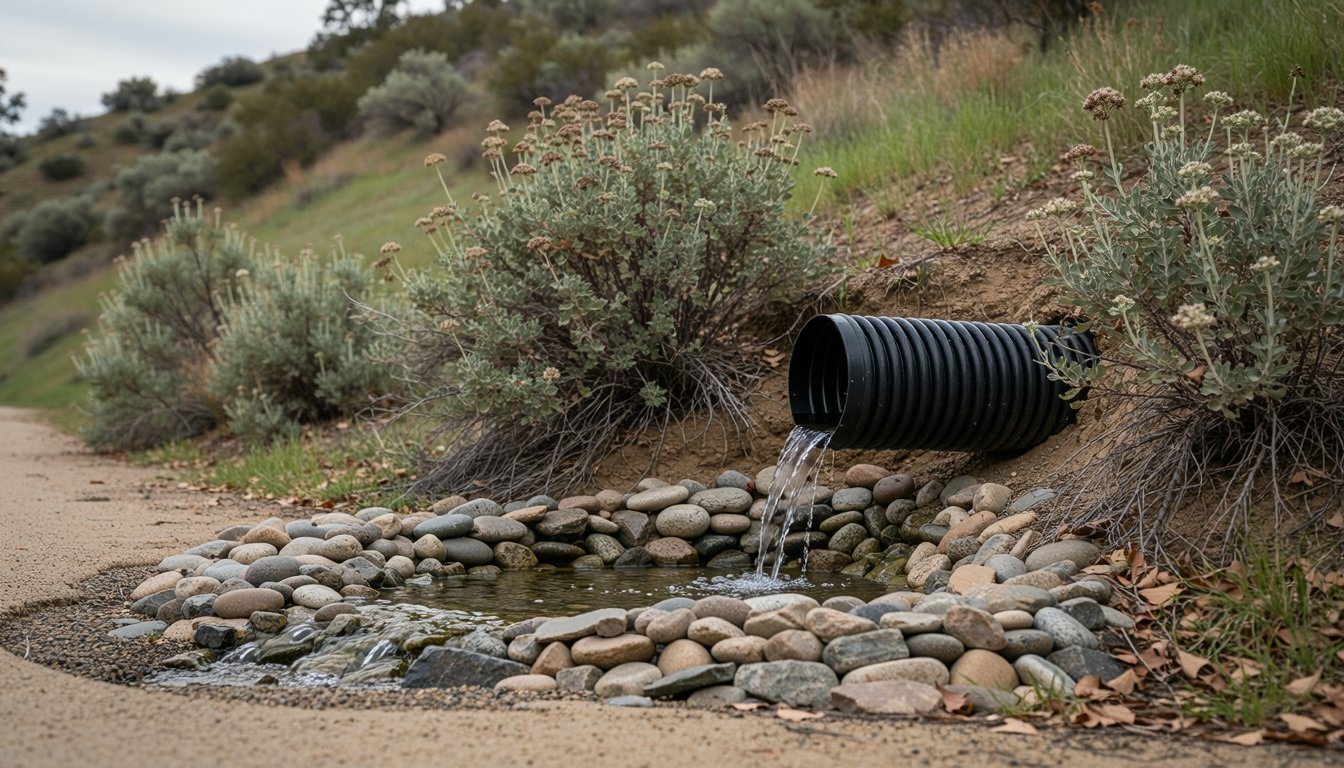
A curtain drain is only as good as its outlet. Oklahoma's fact sheet says "The drainpipe must exit the ground to allow the groundwater to flow out." Indiana's guidance says "To provide an outfall for the drain, one or both ends of the pipe must be extended downslope to a point where it intercepts the ground surface or connects to another subsurface drain." Missouri adds that the outlet should be placed so it "can be free flowing and will not be submerged during a storm." In our experience, where the water may go is where cities vary, so settle the discharge point before digging. Our French drain guide covers outlets in more depth.
The sources don't agree on fabric. Missouri says "Fabric covered pipe is only recommended where fine sand could settle in the pipe." A Forest Service trail-construction figure caption takes the other view for trail drains: "Wrapping French drains with geotextile helps prevent clogging." In our experience, the soil decides it: fine silts and sands that can migrate into the gravel are the case for a filter, and the fabric has to be chosen so it doesn't clog itself.
Curtain drain vs French drain vs footing drain
| Curtain drain | French drain (everyday sense) | Footing drain | |
|---|---|---|---|
| Job | Intercept water moving through the soil | Collect water where it gathers | Collect water at the foundation |
| Where | Upslope of the area to protect | In or along the wet area | At the base of the foundation |
| Runs | Across the slope | Along the wet area, to an outlet | Around the footing |
| Depth set by | The layer the water is moving on | Where the water collects | The footing |
A curtain drain and a French drain can also work together. In our experience, a yard with water arriving from uphill and a low spot that ponds after rain may need a curtain drain above and a surface or French drain below, each doing one job.
The table reflects how the terms are generally used in our experience; contractors don't always use them consistently. A "basement curtain drain" or "foundation curtain drain" usually means a curtain drain placed uphill of a house to keep groundwater from reaching the walls, not a drain at the footing. For footing drains and the drain tile name, see our drain tile vs French drain guide.
The one question that decides it
Before choosing, answer one question: is the water arriving through the soil from uphill, or collecting where you see it? In our experience, these signs point to water arriving from upslope:
- the wet area sits below higher ground and forms a band across the slope;
- the ground keeps seeping after the surface has dried;
- water appears at a cut, a retaining wall face or the uphill side of a slab;
- a test hole fills from the uphill side.
If the water pools on flat ground after rain, or collects at a low spot with nowhere to go, it's collecting in place, and a French drain, regrading or a surface fix is usually the better tool. Our yard drainage solutions guide matches fixes to those problems.
Curtain drains and French drains are the same trench doing different jobs, and the job is set by where the water comes from. The septic-site rules quoted here are examples of how the drain is meant to work, not rules for your yard; local requirements and an engineer's recommendations govern on a real site, especially on a slope. Medici Construction Group is one licensed option for yard and hillside drainage projects, holding California A, B and C-10 licenses under CSLB #1114433.
Frequently asked questions
What is a curtain drain?
A curtain drain is a gravel-filled trench with a perforated pipe, placed uphill of the area you want to keep dry and run across the slope, so it catches groundwater moving through the soil before it gets there. Septic regulators in New Jersey and Indiana call this kind of drain an interceptor drain.
What is the difference between a curtain drain and a French drain?
They're built the same way; Oklahoma's environmental agency even calls a subsurface drain a French or curtain drain. The difference is the job. In our experience, a curtain drain intercepts water moving downhill through the soil, while a French drain in the everyday sense collects water where it gathers.
Curtain drain vs footing drain: what's the difference?
In our experience, a footing drain sits at the base of the foundation and collects water right against the house, while a curtain drain sits away from the house, upslope, and stops water before it arrives. Our drain tile vs French drain guide covers footing drains in more detail.
How deep should a curtain drain be?
Deep enough to cut off the water that's moving, which the site decides. Septic-site rules tie depth to the restrictive layer: Missouri's manual says to dig into it when practical, and New Jersey's rule says to reach its top but not go through it. There's no single depth that fits every yard.
Where should a curtain drain go, and how far uphill?
Uphill of what you're protecting, running across the slope so it faces the water coming down. In our experience, the right distance depends on where the water shows up and how the ground is layered, so it's set after test holes or a look at the soil, not by a fixed number.
Do curtain drains work, and why do they fail?
They work when they're in the path of the water and have a free outlet. In our experience, they fail when they're too shallow to reach the water, placed in the wet spot instead of above it, clogged with fine soil, or tied to an outlet that backs up.
Can a curtain drain protect a basement or foundation?
It can help when water reaches the foundation through the soil from uphill, by intercepting it before it gets to the walls. Water already at the wall, or coming up from below, usually needs a different fix; our French drain around the house guide covers those cases.