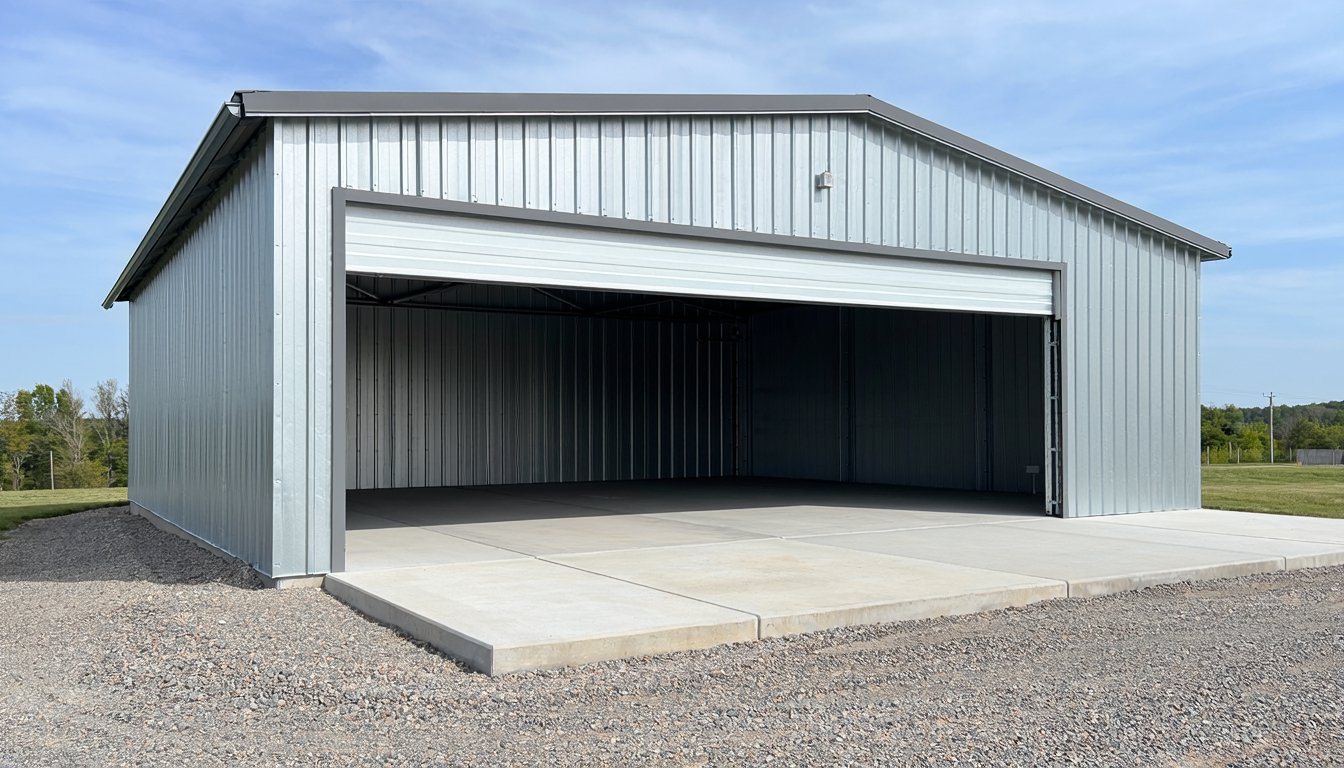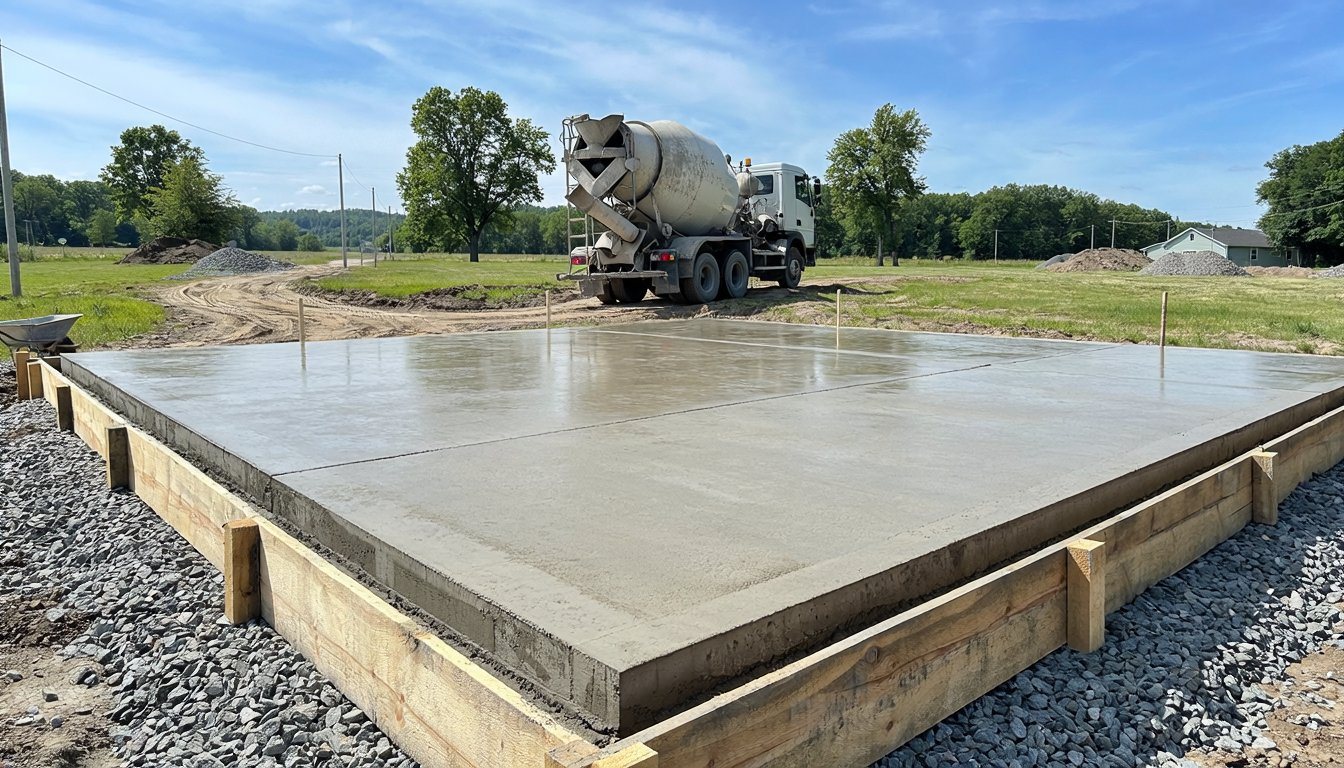
A 30x40 slab is 1,200 square feet, which is big enough that it's usually a pad for something: a shop, a detached garage, a barn, or a metal building. That's why the most important number in the estimate isn't the square footage, which is fixed, but the thickness, because that decides how much concrete goes into it.
Quick answers
- Installed cost: using HomeGuide's rates, about $7,200 to $9,600 for a 4-inch 30x40 slab and $9,600 to $12,000 for 6 inches.
- Concrete needed: about 14.8 cubic yards at 4 inches and 22.2 cubic yards at 6 inches, before any extra for waste.
- Thickness is the big decision: 6 inches takes 50% more concrete than 4.
- Budget separately for extras such as a gravel base, vapor barrier, and site prep.
What a 30x40 slab usually costs
HomeGuide puts installed concrete slabs at "$6 to $12 per square foot on average," and breaks it down by thickness: "$6 – $8" per square foot for 4 inches and "$8 – $10" for 6 inches. Applied to 1,200 square feet, that's roughly $7,200 to $9,600 at 4 inches and $9,600 to $12,000 at 6 inches.
A barndominium site that writes about 30x40 slabs specifically gives a lower range, "$4 to $8 per square foot" with a median around $6, which works out to about $4,800 to $9,600. The two sources don't agree; treat both as reference points and let local quotes settle it.
How much concrete a 30x40 slab takes
The volume is simple math: length times width times thickness, divided by 27 to get cubic yards.
| Thickness | Cubic feet | Cubic yards | Ready-mix at $119 to $147 per yard |
|---|---|---|---|
| 4 inches | 400 | 14.8 | about $1,763 to $2,178 |
| 5 inches | 500 | 18.5 | about $2,204 to $2,722 |
| 6 inches | 600 | 22.2 | about $2,644 to $3,267 |
The per-yard price comes from HomeGuide, which lists ready-mix at "$119 to $147 per cubic yard" for delivery within 20 miles. That's the concrete alone; forming, placing, finishing, and everything under the slab are separate. In our experience, orders usually include a little extra beyond the exact volume to cover uneven subgrade and waste.
Why thickness is the big decision
Going from 4 to 6 inches takes 50% more concrete. HomeGuide's installed price per square foot rises too, from $6 to $8 up to $8 to $10, though by less than the volume does. On a 1,200 square foot slab, that difference is about $2,400 at HomeGuide's rates. On expansive soil, an engineer may call for a post-tensioned slab instead; see post tension slab cost per square foot.
The right thickness depends on what the slab will carry and on the soil under it, so that's a question for your engineer, local code, or the building manufacturer's foundation specifications, not a cost guide. For reference, the barndominium source describes its typical 30x40 package as "six inches of 3,000 PSI concrete."
The extras, priced for 1,200 square feet
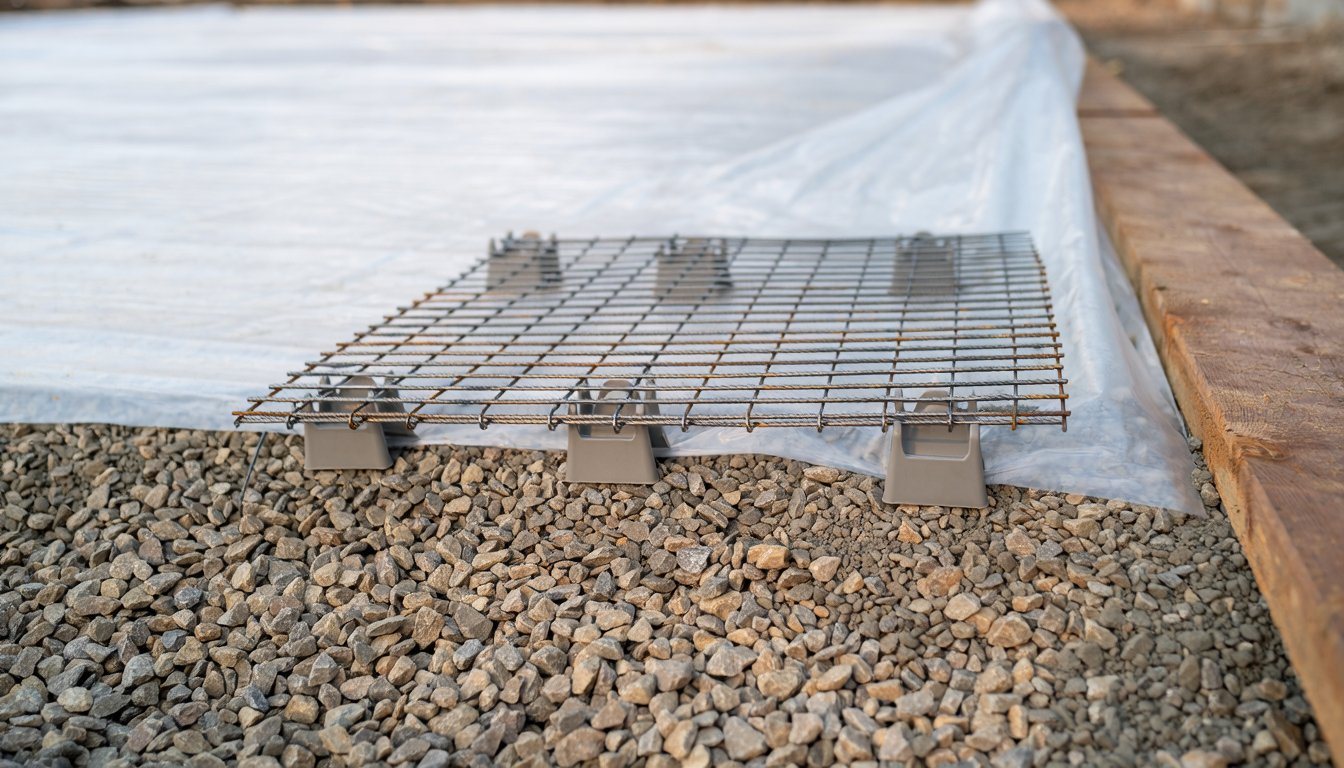
Several items may or may not be in a quote, so it's worth pricing them out for this size:
| Item | Published rate | For 1,200 sq ft |
|---|---|---|
| Gravel base (HomeGuide) | $1 to $3 per sq ft | $1,200 to $3,600 |
| Site preparation (barndominium source) | $0.60 to $1.25 per sq ft | $720 to $1,500 |
| Thickened edges (barndominium source) | $1 per sq ft | $1,200 |
| Vapor barrier (barndominium source) | $0.50 per sq ft | $600 |
| Wire mesh (barndominium source) | $0.40 per sq ft | $480 |
Whether a permit is needed, and what it costs, depends on your jurisdiction and what the slab is for; ask your local building department before you schedule the pour.
How the pour works: trucks, timing, and delivery charges
A slab this size is delivered in loads, and the load count affects the bill. HomeGuide says "A standard ready-mix concrete truck holds 10 cubic yards" and lists a short-load fee of "$30 to $60 per cubic yard" when an order falls under the truck's minimum capacity. Minimums vary by supplier, so ask yours what it is.
Here is what that means for 1,200 square feet. A 4-inch slab needs 14.8 cubic yards, which is one full truck plus a second load of about 4.8 yards. A 6-inch slab needs 22.2 cubic yards, which is two full trucks plus about 2.2 yards. If your supplier treats a full truck as the minimum, that last partial load is about 5.2 yards short at 4 inches and about 7.8 yards short at 6 inches. At the quoted fee that would add roughly $156 to $312 and $234 to $468. That is an illustration built on an assumed 10-yard minimum, not a price, but it shows why many crews round the order up to fill the last truck rather than pay a penalty on a small load.
Time matters too. HomeGuide says suppliers allow "5 to 7 minutes per cubic yard" for unloading and lists overtime charges of "$2 to $5 per minute" beyond that window. Across 14.8 yards, the allowance is roughly 74 to 104 minutes; across 22.2 yards, roughly 111 to 155 minutes. Thirty minutes of overtime would cost $60 to $150. The takeaway is practical: forms, base, vapor barrier, and reinforcement should all be finished and inspected before the first truck arrives, and the crew should be big enough to place and screed at the pace the trucks deliver.
If the trucks can't get close to the forms, a pump may be needed. HomeGuide lists line pumps at "$150 to $300 per hour", boom pumps at "$200 to $500 per hour", and a minimum rental of 2 to 4 hours. At those figures, a pump could add anywhere from about $300 to $2,000 to the job. Whether you need one depends on access to the site, so it is worth asking each bidder to state it as a line item or to say it is not required.
Control joints on a 1,200 square foot slab
A slab this big will crack somewhere; the goal is to decide where. The National Ready Mixed Concrete Association's guide to joints says "Cracks in concrete cannot be prevented entirely", but properly designed joints can control and minimize them. It gives a spacing rule: maximum joint spacing of 24 to 36 times the slab thickness. For a 4-inch slab, the same guide puts that at about 10 feet. It also advises that "All panels should be square or nearly so" and that the length should not exceed 1.5 times the width.
Applied to this footprint, that arithmetic gives a rough sense of the layout. At a spacing of about 10 feet, a 30x40 slab divides into 12 panels of 10 by 10 feet, which takes about 170 linear feet of saw cuts (three 30-foot cuts and two 40-foot cuts). Thicker concrete allows wider spacing: 24 to 36 times 6 inches is 12 to 18 feet, so a 6-inch slab could be cut into six panels of roughly 15 by 13 feet, about 100 linear feet of cuts. Treat those as an illustration of how the rule scales, not a joint plan. The engineer's or building manufacturer's drawings control the actual layout, and columns, doorways, and interior walls can change it.
Timing is part of the cost as well. The same guide says conventional saw cuts "should be run within 4 to 12 hours" after finishing. In our experience, that means a saw and operator on site the same evening or the next morning, and it is worth confirming that the quote includes them.
Why the vapor barrier and curing are not optional extras to cut
Two of the cheaper line items in the table above do more work than their price suggests. A vapor retarder costs $600 at the barndominium source's $0.50 per square foot, and a technical sheet from the ready-mix industry describes its job this way: "Vapor retarders are sheet materials that minimize the transmission of moisture or water vapor from the sub-slab support system into a concrete slab." The same sheet warns that "Permeation of water vapor through concrete slabs can cause failure of moisture-sensitive adhesives or coatings resulting in delamination, distortion or discoloration of flooring products." If your 30x40 slab is a shop floor that will stay bare or get a coating, ask your engineer and flooring installer whether a vapor retarder is needed for your conditions.
Curing costs little in materials but depends on the crew doing it. The NRMCA defines it as "maintaining newly placed concrete at adequate moisture and temperature conditions so that it can develop properties, such as strength and durability" the mix was designed to achieve. It adds that curing "should be continued for a sufficient period of time, typically 3 to 7 days" and warns that concrete in a dry environment "can lose as much as 50 percent of its potential strength" compared with moist-cured concrete. A slab that dries too fast after a $10,000 pour is a poor place to save money, so ask each bidder how the slab will be cured and for how long.
What could push the number up or down
Beyond thickness, the biggest swings tend to come from things a calculator does not see. In our experience, the main ones on a slab this size are:
- Access. Tight sites that need a pump, or long hauls beyond the supplier's delivery radius, add cost. HomeGuide lists delivery beyond the standard radius at "$0.50 to $2.00 per mile".
- Grade. A site that is not level needs more grading, more base, or deeper edges to get a flat pad.
- Soil. Soft or expansive soil can change the design and the price, which is why a soils report or engineer review comes before the bid on a slab that carries a building.
- Timing. Trucks that arrive late in the day or with an unprepared crew can turn into overtime and rushed finishing.
Ask every bidder to list these separately, so you can see which quote is carrying them and which is leaving them for change orders later.
A worked estimate
Say you're pouring a 6-inch 30x40 slab for a shop. HomeGuide's installed rate gives $9,600 to $12,000. If your quote doesn't include a gravel base, HomeGuide's base rate adds $1,200 to $3,600, for a total of about $10,800 to $15,600. Be careful not to double-count: ask each contractor whether their installed price already includes base preparation before adding extras on top. This is an illustration built from published national rates, not a quote.
Getting quotes you can compare
Ask every contractor to state the thickness, the concrete strength, what's under the slab (base, vapor barrier, reinforcement), whether thickened edges are included, and who handles any permit. With those spelled out, quotes become comparable. If the slab is the foundation for a building, our house foundation cost guide covers how foundation type and soil affect cost. Medici Construction Group is one licensed option for concrete slab work, holding California A, B and C-10 licenses under CSLB #1114433.
Frequently asked questions
How much does a 30x40 concrete slab cost?
Using HomeGuide's installed rates, about $7,200 to $9,600 at 4 inches thick and $9,600 to $12,000 at 6 inches. A barndominium source gives a lower range of about $4,800 to $9,600. Extras like a gravel base can add more.
How many yards of concrete for a 30x40 slab?
About 14.8 cubic yards at 4 inches, 18.5 at 5 inches, and 22.2 at 6 inches, before extra for waste and uneven ground.
How thick should a 30x40 shop slab be?
It depends on the loads and the soil, so your engineer, local code, or building manufacturer should set it. One barndominium source describes a typical 30x40 package as six inches of 3,000 PSI concrete.
How much does it cost to pour a 30x40 slab yourself?
The ready-mix alone runs roughly $1,763 to $2,178 at 4 inches and $2,644 to $3,267 at 6 inches at HomeGuide's per-yard prices, plus forms, base, reinforcement, tools, and help. At 400 or more cubic feet, bagged concrete would take hundreds of bags, so a slab this size is realistically a ready-mix pour.
How many truckloads of concrete for a 30x40 slab?
At HomeGuide's 10 cubic yards per standard truck, a 4-inch slab (14.8 yards) takes two loads and a 6-inch slab (22.2 yards) takes three, with the last load partial. Ask your supplier about its minimum load and any short-load fee.
Does a 30x40 slab need control joints?
Cracks can't be prevented entirely, so slabs are normally cut or tooled with joints to control where they form. The NRMCA gives a maximum spacing of 24 to 36 times the slab thickness, which is about 10 feet for a 4-inch slab, but your engineer's drawings set the actual layout.
Do I need a permit for a 30x40 slab?
It depends on your jurisdiction and what the slab supports. Check with your local building department before scheduling the pour.